Reflections and Beyond
Building narrative capacity with the Asian Development Bank

This is edited from a case study write up by me and Paul Corney in 2011 of a partnership with the Asian Development Bank in 2008 - 2009 with extracts from the method and works we produced and some memories from me. With apologies for email recipients that you’ll need to go into Substack to read the whole, but I don’t want to break it up. Also I bet there are copyedits to be made, but you know, publish your drafts wildly and often, says Defra’s agile communication guide. So yep, that’s what I’m doing.
It’s November 2008, hot and humid and the typhoon season is nearly over. The atrium in Asian Development Bank’s Head Office in Metro Manila is crowded with a group of staffers and guests interested in understanding how they might use storytelling for knowledge sharing and learning.
It’s 2008. A Sparknow team (Paul and Carol) is running a ‘story in a word’ (See SDC story guide) workshop as part of a visit organized by ADB’s Knowledge Management Center. We are to help assess ADB’s capacity in using narrative techniques. The 80 or so delegates have been asked to select a word or phrase from the bank’s mission statement and to tell a story of how it illustrates the values of the bank in action. Animated conversation ensues as participants’ initial reticence evaporates. Gradually a pattern emerges: the audience has lots of examples of what phrases such as “...alleviating poverty...” mean to them. After everyone has told their story to a small group, volunteers are sought to address the wider gathering.
What happened next provided a salutary reminder of the power of a story to cut across hierarchy, race, gender and age; the audience listens in silence while a man describes unsuccessful attempts to save a dying child suffering from malnutrition and why he then joined the Bank to help alleviate poverty.
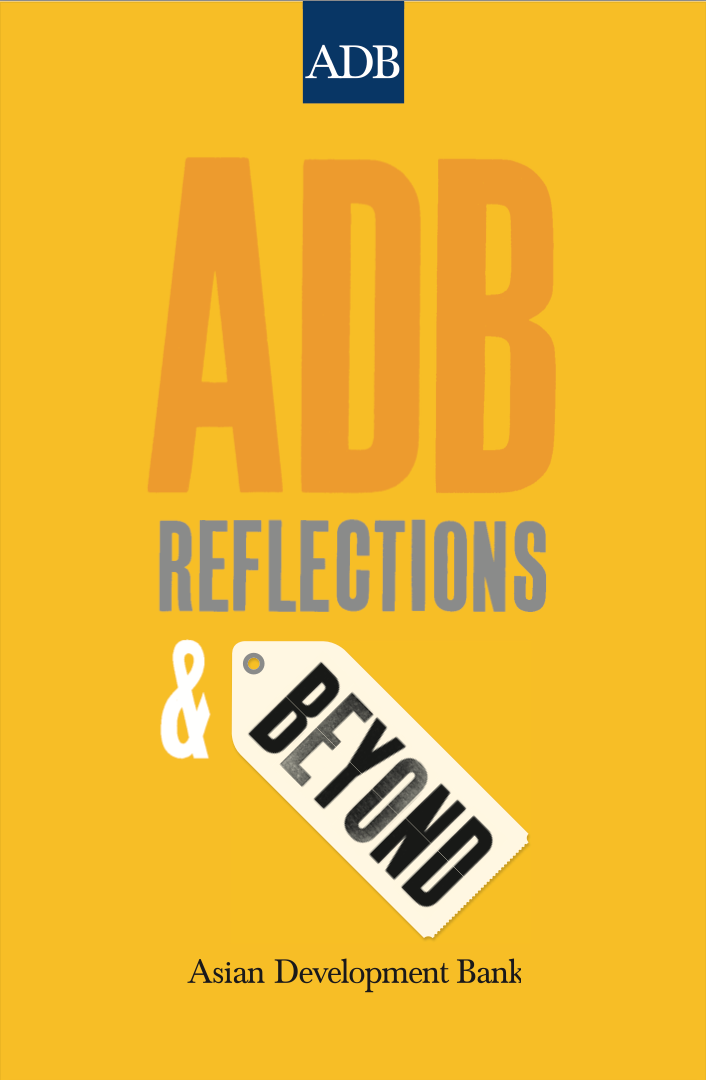
18 months on and ADB’s President Kuroda is speaking to staff at the launch of ADB’s ‘Our People’ strategy - a document setting out principles for how the Bank will recruit, motivate, and manage its workforce to achieve it’s Strategy 2020 goals. Among the materials handed out are two items from ADB’s Living Archive: a book, ADB: Reflections and Beyond and a CD, Beyond: Stories and Sounds from ADB’s Region.
Here we trace the development of that Living Archive and ADB’s 18- month journey, from the story in a word workshop to the eventual adoption of a knowledge management project as a key part of an employee engagement strategy in the ‘Our People’ strategy launch.
This article shows how an initiative grounded in knowledge management can be incubated, shaped, given momentum and then embraced by a cross section of the Bank’s operations. Teams from knowledge management, marketing and communication, human resources and learning, as well as strategy and planning all pulled together to make this happen.
We explore some of the techniques used to capture content that forms the living archive.
What is a living archive?
The term living archive is one we worked out together. It started out as a one-year project to build what our client called ‘narrative capacity’ right across the Bank. It comprises a collection of materials that help staff stakeholders and partners improve their understanding of, attachment to and empathy with, the organization:
a set of catalogued audio clips for use in induction, podcasts and training
a manual for a capacity building to support ADB in evolving story processes and practices across the organization
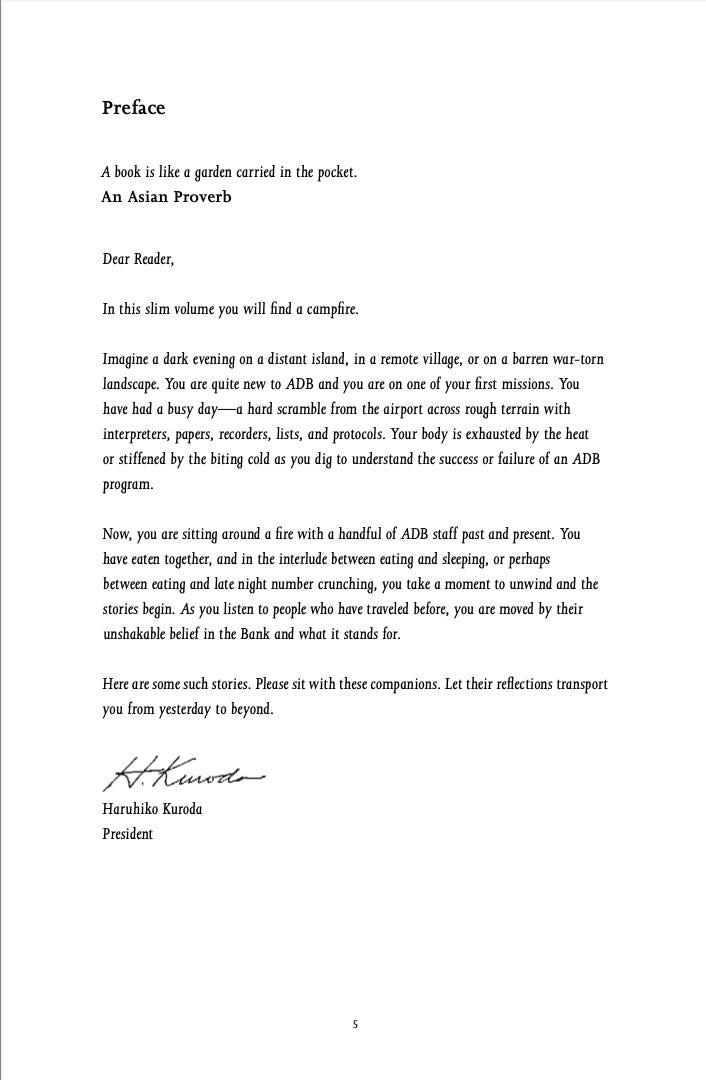
ADB: Reflections and Beyond, publication capturing significant events in ADB’s history told through the eyes of some of those who were involved
a set of tools and techniques such as timeline trigger which ADB has been able to reuse.
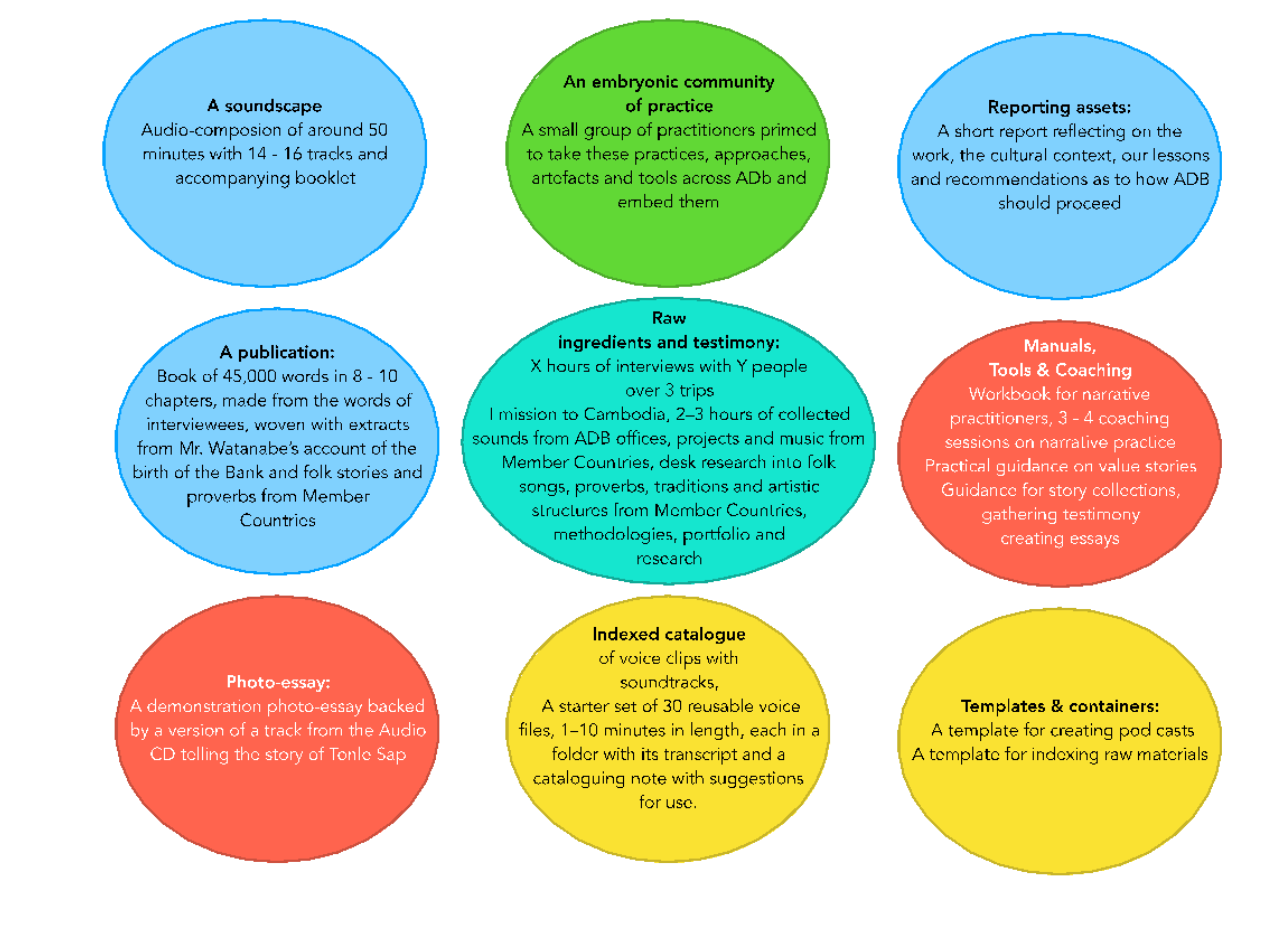
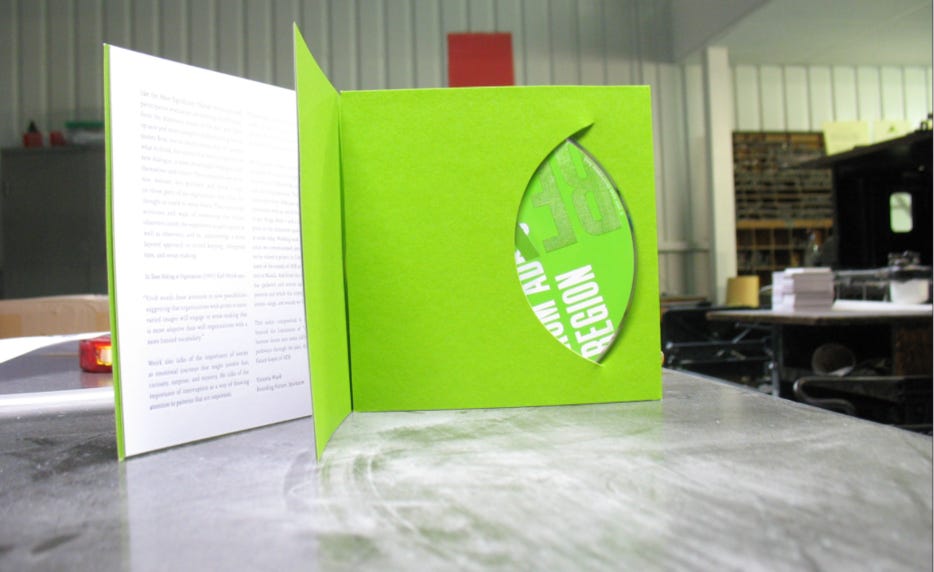
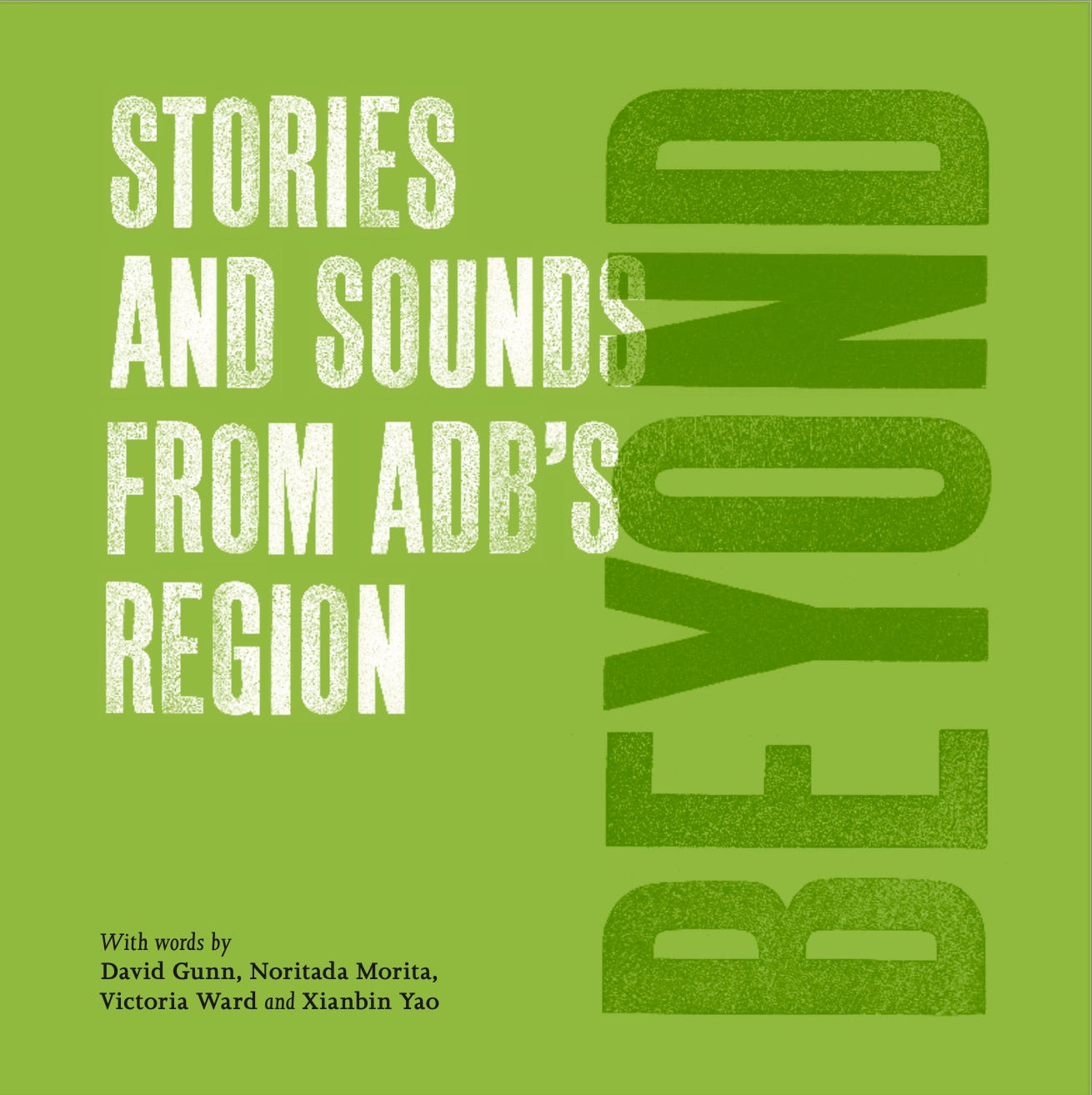
We added a gift to this collection, commissioned and funded by us. ‘Beyond: Stories and sounds from ADB’s region’ is a CD featuring the sounds of ADB and Asia as a backdrop to many illuminating reminiscences from the interviews about working for and in ADB
Building a living archive
Laying foundations
The Bank had identified a gap (insufficient means of capturing and storing its vast wealth of tacit experience) and, having heard Islamic Development Bank (IDB) describe how they’d tackled the issue of transferring knowledge from retiring staff, the knowledge management lead commissioned a project to build ‘narrative capacity’ right across the Bank, developing the means, through new skills and innovative products, by which ADB might hear itself and learn from past and present experience.
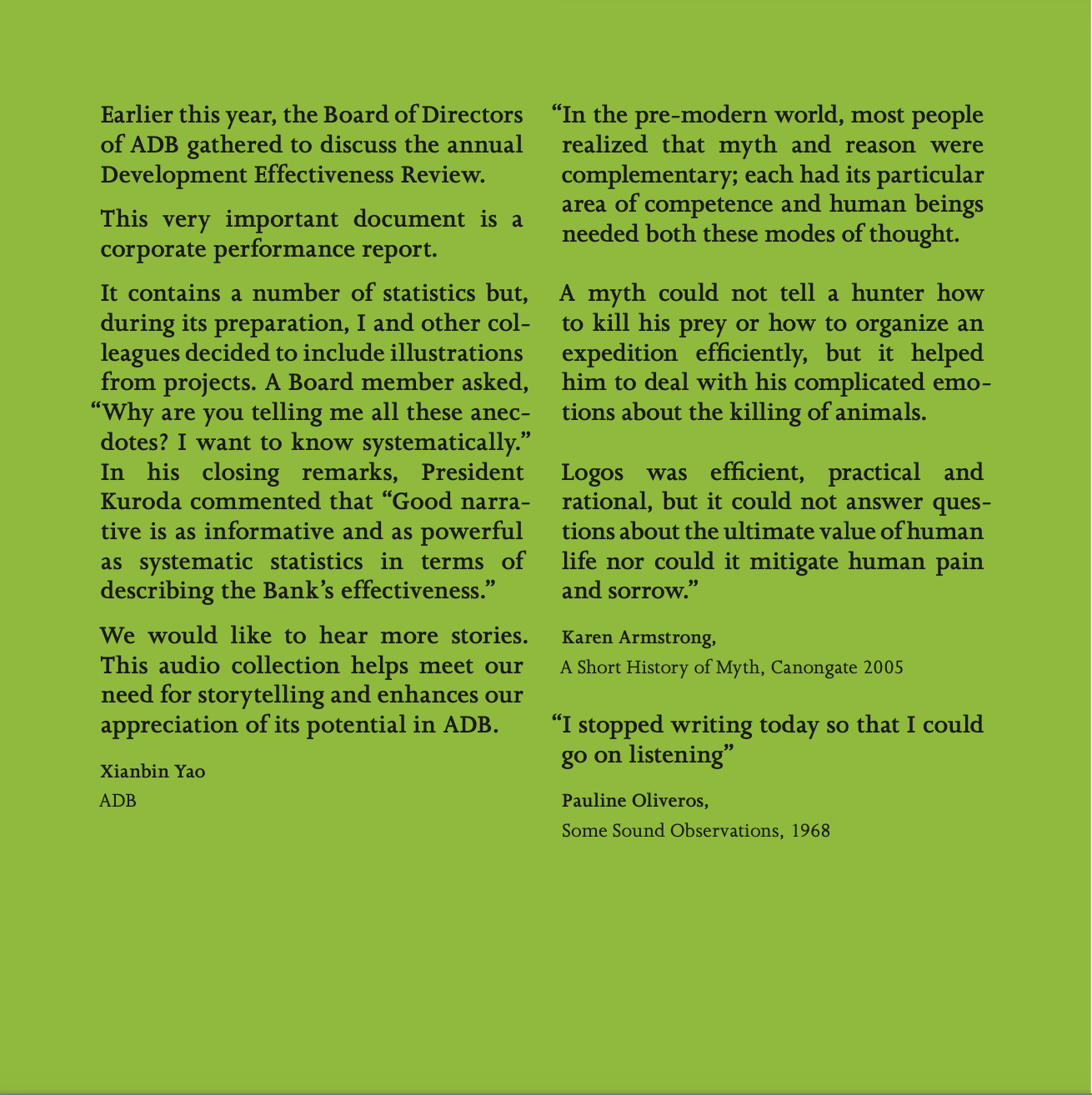
In 2009, the Board of Directors of ADB gathered to discuss the annual Development Effectiveness Review. This very important document is a corporate performance report.
It contains a number of statistics but during its preparation I and other colleagues decided to include illustrations from projects. A Board Member asked, ‘why are you telling me all these anecdotes? I want to know systematically’. In his closing remarks President Kuroda commented that ‘Good narrative is as informative and as powerful as systematic statistics in terms of describing the Bank’s effectiveness’.
taken from Xianbin Yao’s Director General, Regional & Sustainable Development ADB, introduction to the CD, Beyond: Stories and sounds....
We knew that oral history books and reminiscence are hard to do well in a way that is truly gets under the skin of an organization. We also thought that something very different needed to happen that would bring life and beauty and surprise to the work.
So we (Paul J Corney and Victoria Ward from Sparknow) decided to work with master craftspeople. Carol Russell, a writer/storyteller, has been an associate of Sparknow since its inception so we knew we wanted her on the team. The others we invited were David Gunn, then of Incidental, to capture sound and create the CD, Brian Webb of Webb & Webb, who would prove to be imaginative designers of the publication, and Phil Abel of Hand and Eye a traditional letterpress printer. Will Ross of Spanner had devised Kobble, our narrative database, for us, for other projects and supported us throughout. Laura Humphrey, then Nokes, joined later on in the project as copyediting parter to Carol and Victoria.
We decided to adopt a collection method that relied on a single process of capturing materials that would then be used in multiple ways; in the publication, podcasts, set of catalogued clips, CD and the manual.
Engaging stakeholders
In any multicultural parastatal organization, ethnic groups tend to communicate and socialize more with those from their region; national staff congregate with other national staff. Engaging all groups across cultures, creed and gender was key as was including the former employees and the core operating units of the Bank and getting their support.
Sparknow developed a communications plan that recognised these diversities, cultural nuances and different ways of working; ADB’s KM Center selected interviewees for their potential insights and experience not for their seniority or nationality. Launch events were open sessions held in the atrium alongside the in-house Starbucks and library. Issues around technology, style, format and contravention of brand guidelines were discussed and resolved early on in joint meetings with ADB's Department of External Relations. All promotional material was posted by their KM Center on ADB’s intranet for general access, as were the results of ADB’s annual KM survey, to ensure the process was as open and accessible as possible.
Assessing the narrative ecology at the start
Cultural indicator
The story had begun in November 2008, when we arrived in Manila to inquire into ADB’s use of narrative and identify promising areas where it could be applied to bring the experiences and memories of the organization alive.
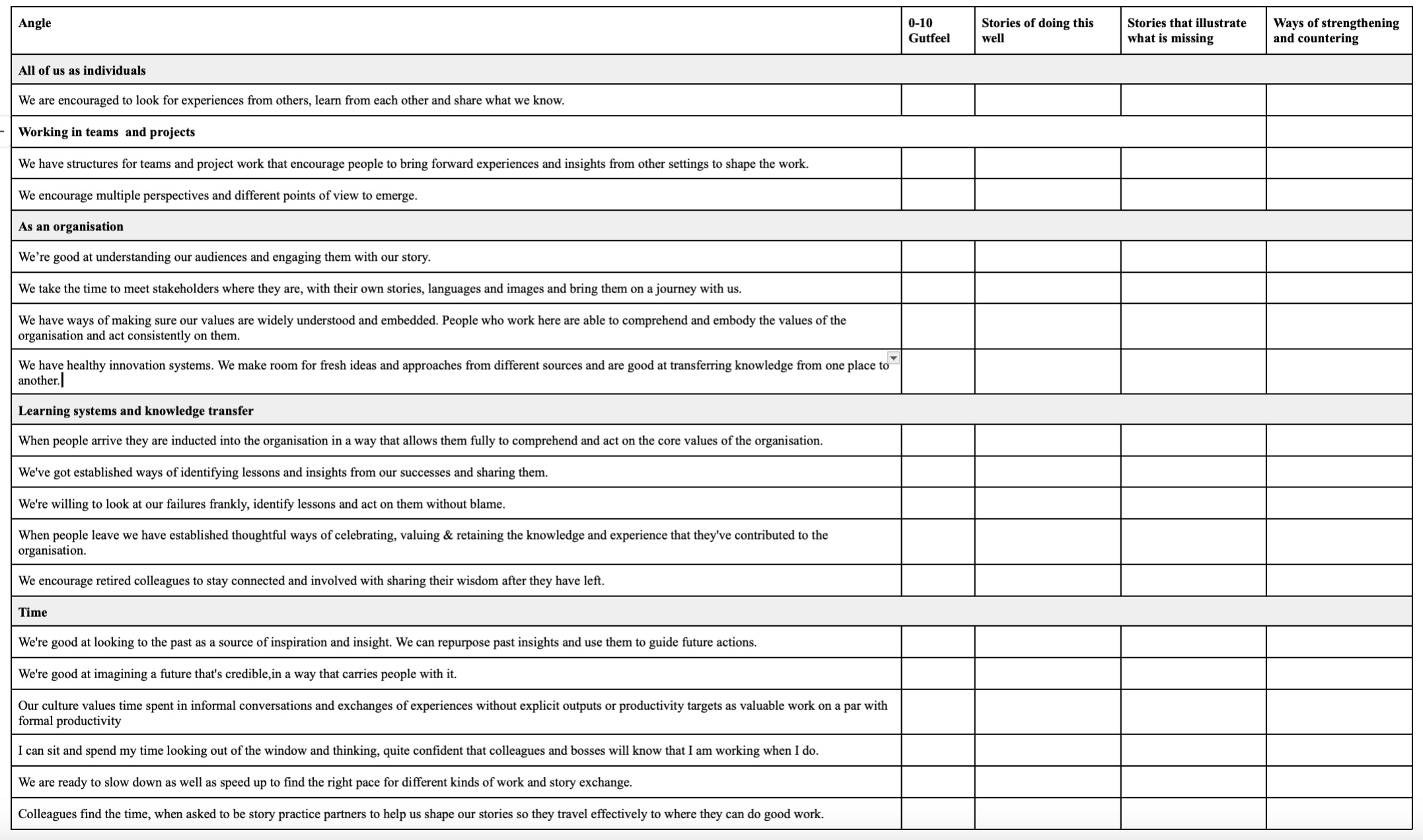
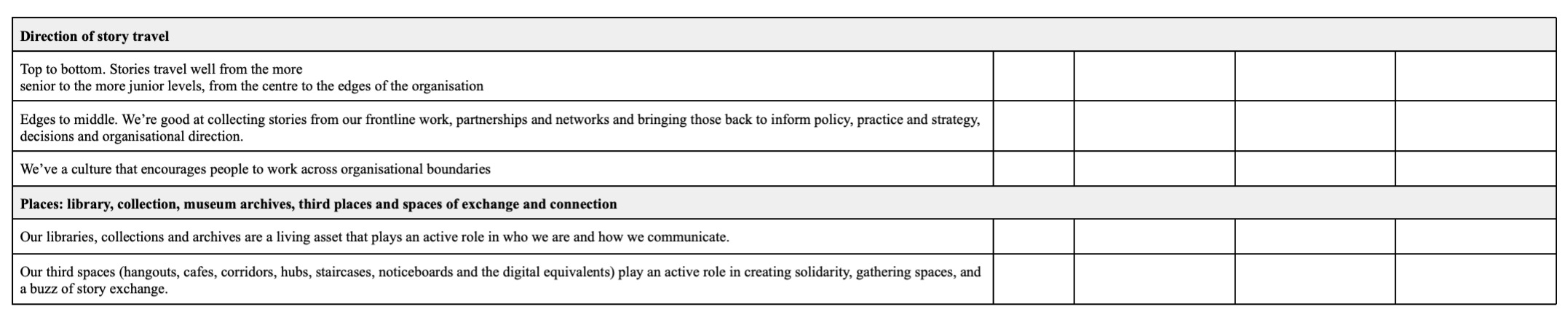
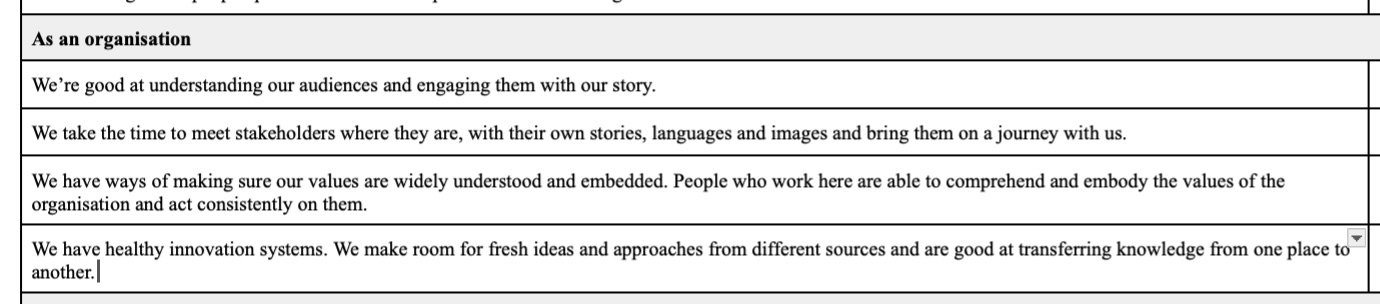
We used a measurement tool, a cultural indicator to gauge how ADB worked. In a series of short interviews we asked interviewees to respond to a set of yes/no questions and to give examples of one yes and one no answer. Here’s an extract:
Value stories
We also ran a workshop with selected colleagues where we took existing ‘impact’ stories that sought to demonstrate the value of the ADB to its regions, funders and beneficiaries. Pairs read an impact story and then used a grid based on our SDC story competition grid to evaluate them.
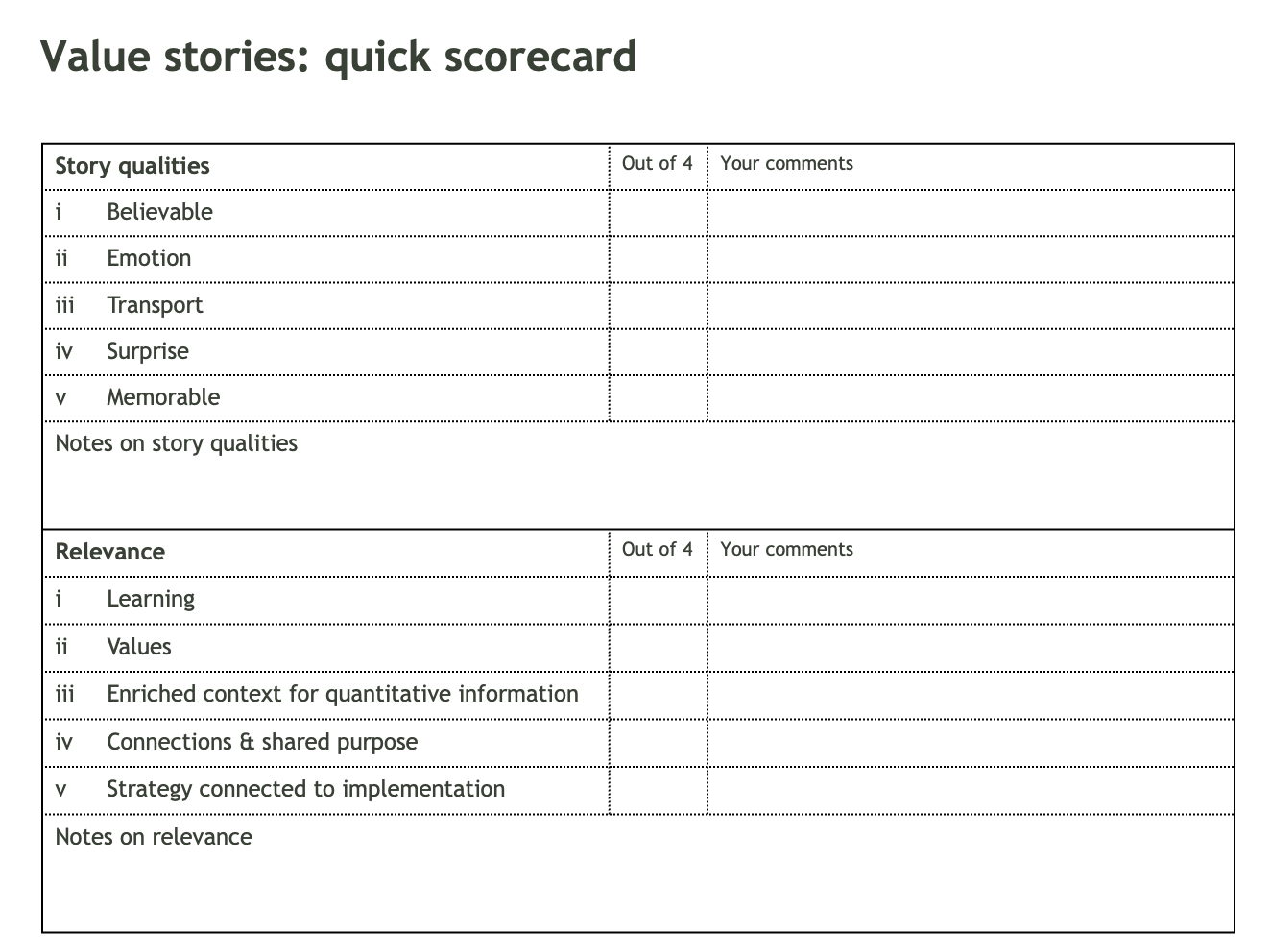
This illuminated a number of aspects of the values stories. What sticks in my mind most from that workshop in Manila is the cultural mismatch sometimes. The writers of impact stories might be people drawing on western mythologies, narratives and characters - Icarus few too close to the sun somehow sticks in my mind, from Greek mythology. But in fact the readers, and those who needed to be moved, would generally come from quite different narrative ecologies and histories and would be moved by quite different imagery, we thought. There were also considerations around putting in plausible characters, from ADB world (say project managers) to mediate the gap between a huge and faceless institutions, and the impact on the ground. Very often these mediating characters were missing. Something to say more about another time. It did have a direct impact on the way we recombined the materials into the final ‘Beyond’ book we produced.
Timelines of change: finding the turning points
When we returned in March 2009, we decided to use a similar timeline trigger technique to that we’d used with IDB: to map the course of ADB’s history through personal recollections to find clues about where to look.
Long tables were laid out in ADB's atrium (the same as that used for the earlier workshop) with a timeline by decade. We asked people to plot their own significant moments (personal turning points), and those they felt to be turning points in ADB’s longer history.
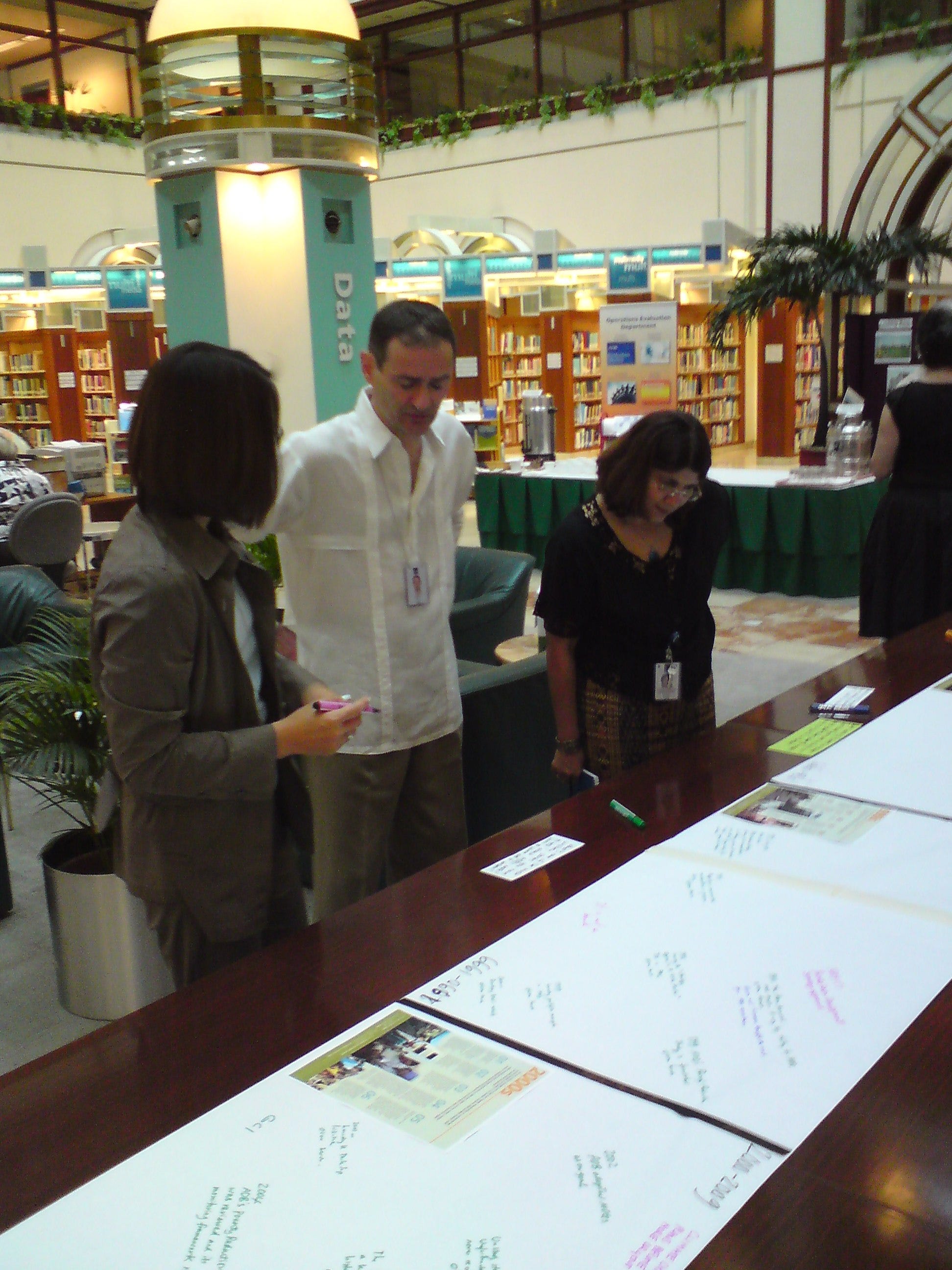
The timeline exhibit: worked to provide a good overview of what people were interested in knowing about, hence the areas for inquiry during the interview process; enabled people to have a voice in designing the process, a sense of engagement; and, was part of the communications strategy we’d agreed at the outset. It would help to recruit potential interviewees and create a feeling of anticipation.
We now had a sense of the turning points in ADB’s history and what people were interested in learning more about.
Our challenges: to get face time with the people whose stories would illuminate the Bank’s history, and to find conducive settings for the intimate and often reflective spells that accompany the in-depth discussions yet devoid of the outside noise that renders recordings unsuitable for reproduction on CD.
After the exhibit and later in June 2009, we conducted more interviews to add to those from November 2008. All interviews were recorded with a main interviewer and a second to take notes.
Interviewees (from all levels at ADB and their alumni network) were briefed in advance and asked to bring along an object or image reminding them of a notable incident or story from their career.
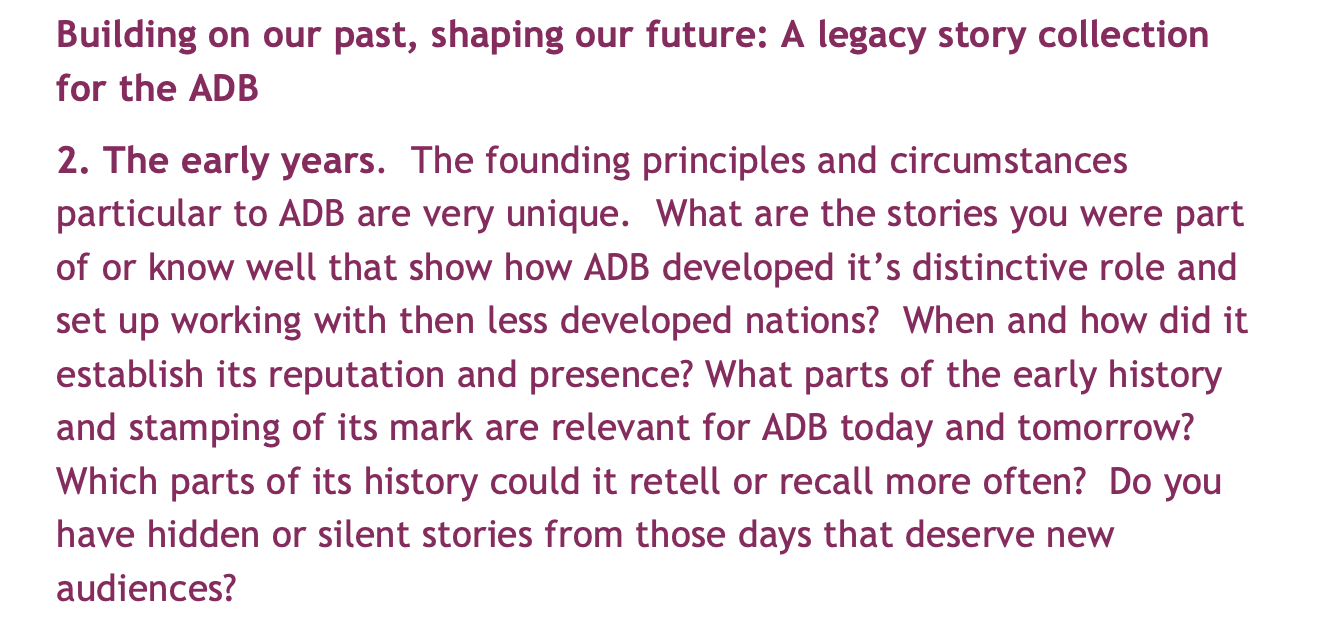
The total process yielded 39 hours of interview material.
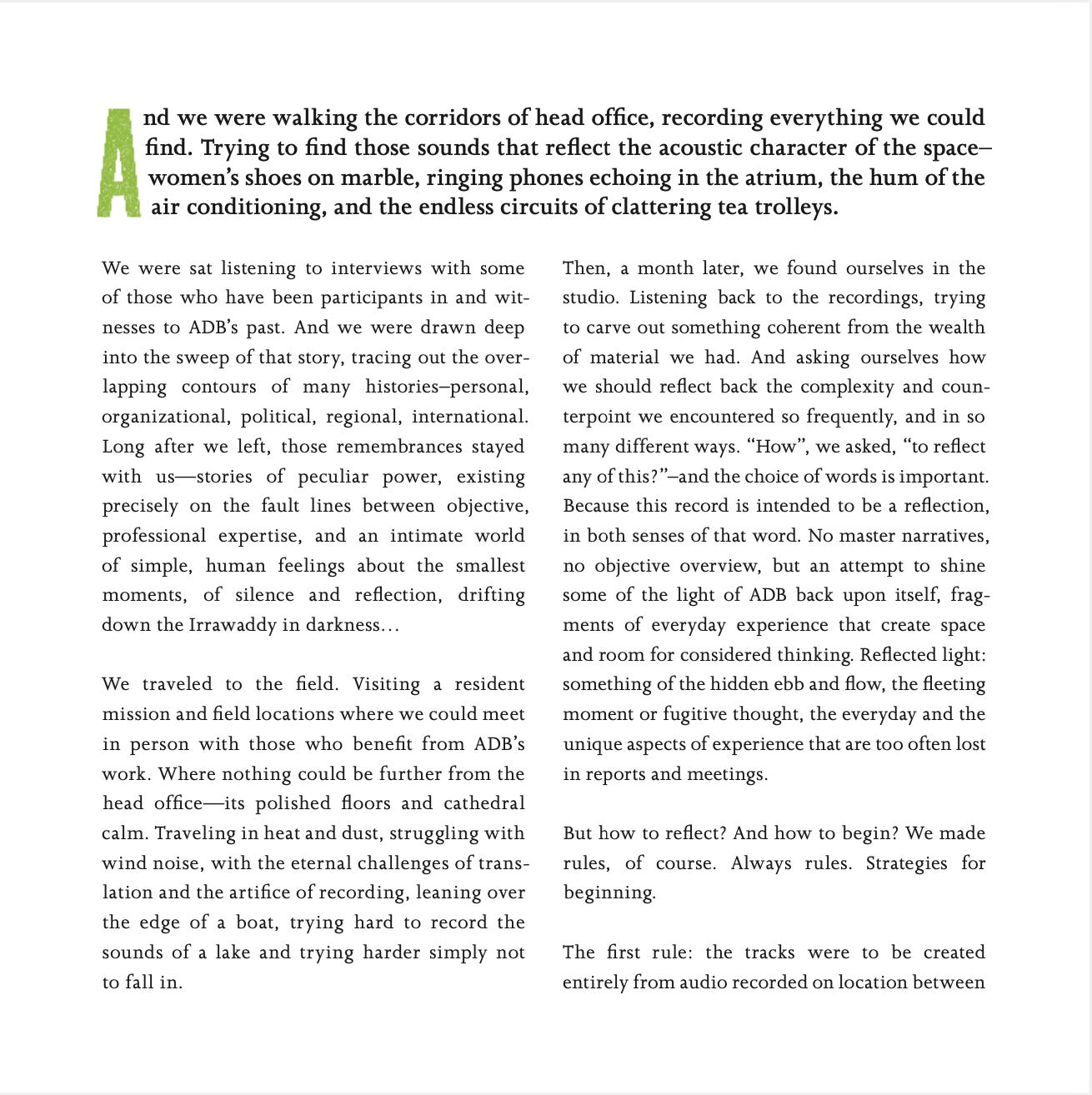
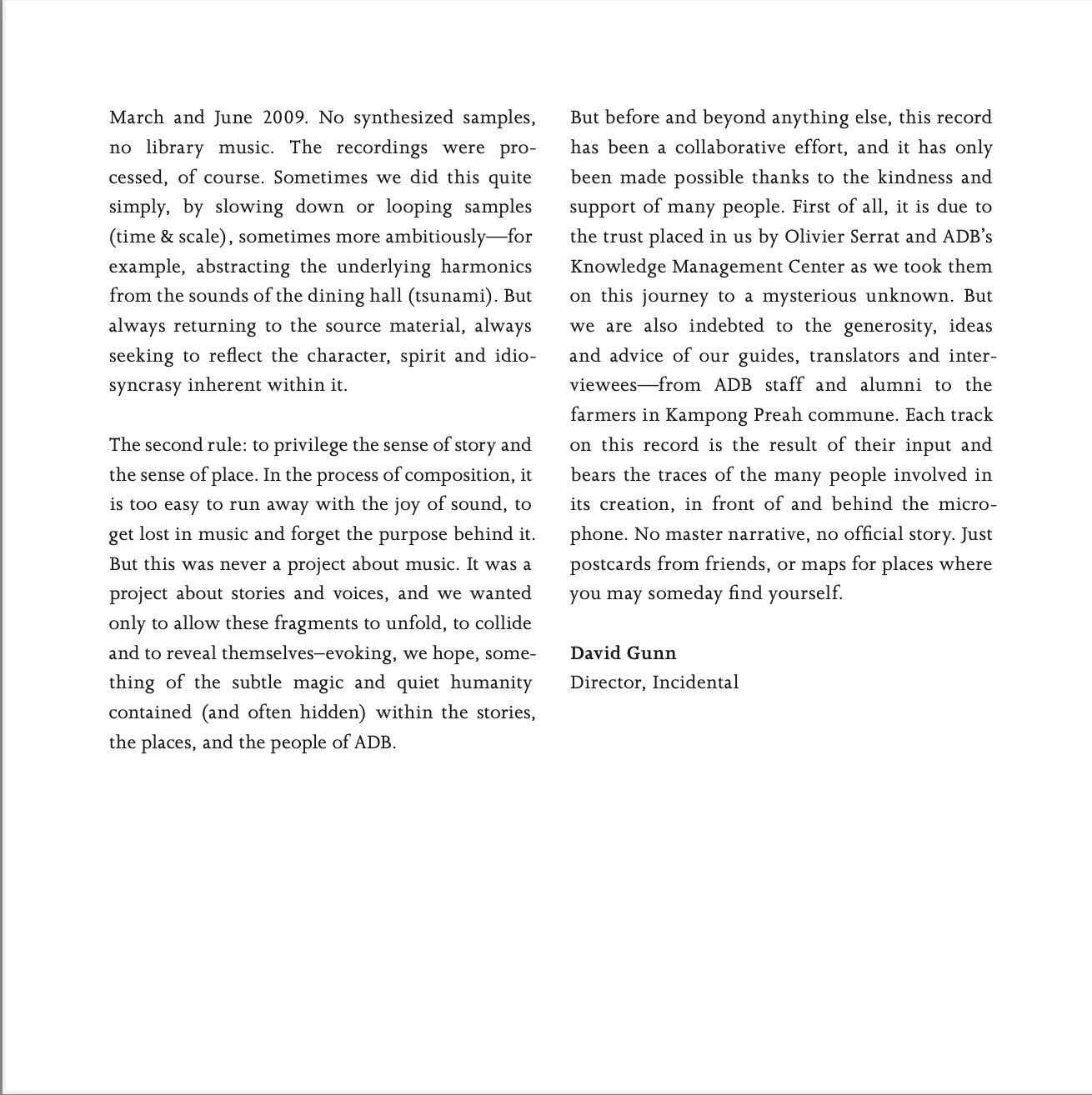
While this was happening David Gunn, the sound artist, had crept round ADB headquarters recording ceremonial drums, footsteps and tea trolleys, and had started work on a composition in sound that would splice small slices of voice together with found sound and music to create a soundscape of the Bank at work.
We were dealing with often controversial and confidential information and it was important to strike a balance between disclosure and censorship. So we started to look to folklore and proverbs to provide a middle ground between fact and fiction that would allow us to reshape some true episodes through fictional forms from ADB countries that could give us a vehicle to allow complex insights to travel without shame or embarrassment. Over the next few months we worked (often around the clock making the most of the time zone differences) to synthesize and sensitize the material collected.
Concurrently another component of the living archive was taking shape from the interview material: a catalogued collection of 30 audio clips and transcripts from the interviews and the soundscapes that were to become an invaluable asset for induction, engagement, provocation pieces at meetings and in promotional and educational material. We wanted staff to hear among other things the Manager Director General’s brilliant and concise summary of how development banking has evolved and ADB’s role in that.
Assembling and combining
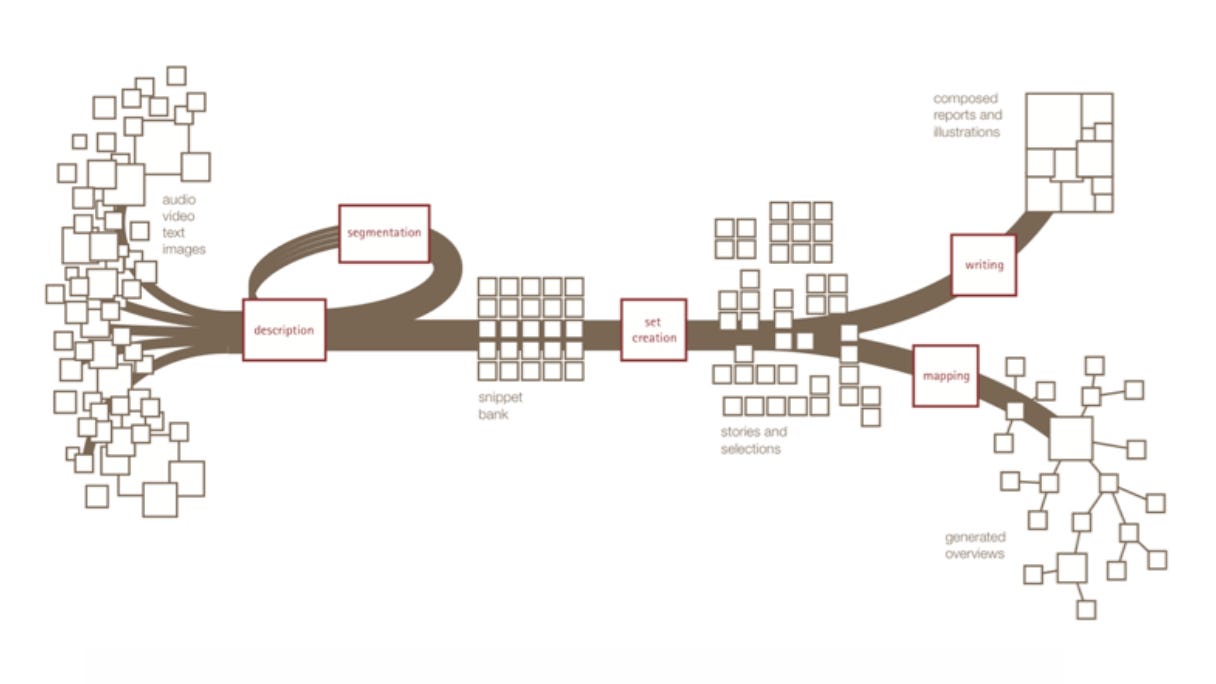
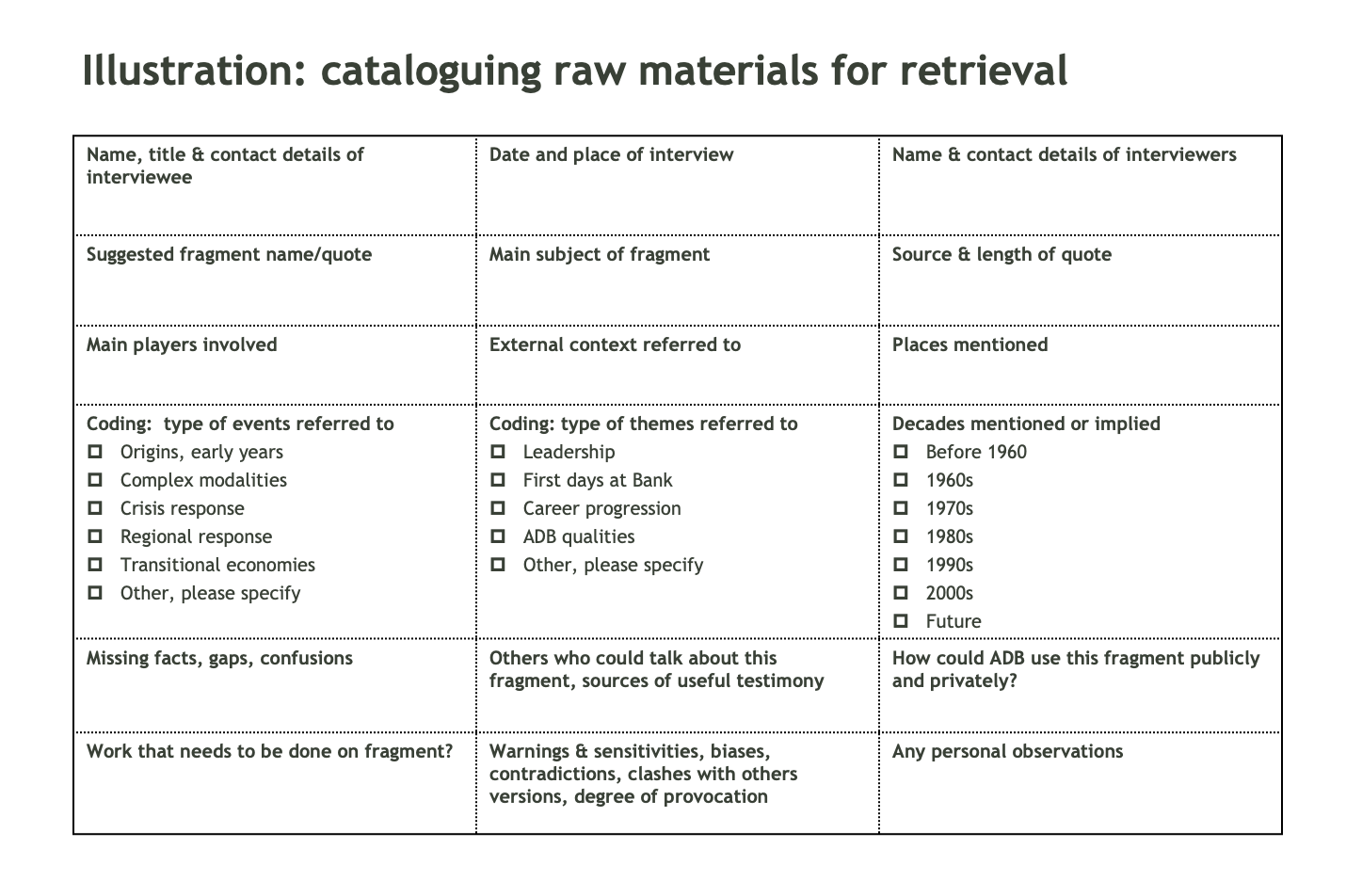
The interviews were all transcribed and dropped together with the voice files into a narrative database specifically developed for Sparknow, then called Kobble. Kobble allows us to segment voice and text, extracting nuggets of particular relevance or value without losing their connection to the source material. In parallel, we had created a keywording schema that allowed Sparknow researchers to trawl and sift the materials, looking for themes, patterns, gaps, insights, and anecdotes. We ended up with over 400 fragments, 55 sets, and 240 keywords that were used more than once.
Designing
We talked and argued with our designers and printers about the kind of design and production values that would hook the publication and CD together. How to use traditional, tactile materials with a contemporary, forward looking feel that could set a tone of looking to the future; that would balance out the folklore? So we looked to a groundbreaking moment in visual design from the Italian futurists for our clues.
And finally, what to call it? We wanted something that would highlight the lyricism we found in the stories. Here were people who worked hard but still found time for joy and laughter, people who still took time to notice the poetry around them.
We had been listening to the audio composition we were gifting to the client that was to be entitled Beyond: Stories and Sounds from ADB’s Region. We went back to our clients, we went back to our recordings, and we found a missing word that had not been transcribed. That word was ‘beyond’. It had somehow got swallowed and fallen off.
After further discussion settled on ‘ADB: Reflections and Beyond’. It felt right as that linked the publication with the audio composition and described the journey of the book. Reflections of ADB from its yesterdays.
The methodology note at the end of the book we produced is reproduced at the end here and says some more about our interdisciplinary approaches to design. It seems wildly necessary, looking back on it, that we had ferocious, lively debates about the aesthetics of the works were producing. It took everyone, and all perspectives, to find design principles that were both soaring in ambition and rooted in deep values we all brought to the work.
And in the end
‘ADB Reflections and Beyond was launched last February by our President. It was a big success. The little ‘Yellow Book’ can be seen on the desks of many staff’. (February 2009)
The publication became widely embraced (a further 1,500 (on top of the original 1,000) were printed; the book and the soundscape are (still in 2025) available for download on ADB’s website, the catalogued audio clips featured many times in ADB meetings, induction sessions and their intranet postings in the time immediately after the work. The 2011 Asian MAKE panel has recognized the Asian Development Bank for collaborative enterprise-wide knowledge sharing. This was the first time that the Asian Development Bank had been recognized as an Asian MAKE Winner.
Just before the end (which was of course the beginning) there was a glitch, which turned out to be a happy accident. We had planned for the publication to be distributed around Christmas 2008 as a seasonal gift. The deadline for publishing came and went. This was a great piece of luck because, instead of being a gift, it became part of a new induction launch, as I recall, and so was somehow more formalised and embedded into the stories of the culture to guide people in carrying the ambitions of the founding of the ADB into its future activities and mission.
Three moments that stick in the memory
A coda from me is three favourite moments from this experience.
First, was the moment that David made from sound and Norman Liu’s story of keeping the website up during the tsunami. I loved the way that a locally employed Filipino told the story of a major crisis, and the role that he played in serving the Bank’s mission in that crisis. You will find Tsunami as the sixth track on the soundscape at an old Soundcloud playlist.
Tsunami 2:58
Ambient noise, air conditioning units, and automatic door jets from ADB Headquarters; security guard radios and metal detectors; interview with Norman Lu
A second thing that sticks with me, apart from how glorious Manila was, is how David and I had a very fierce creative partnership in the production of the soundscape. He veered to abstract. I insisted on stories being told in the fragments we chose from our narrative recordings. I think we found a pretty good balance.
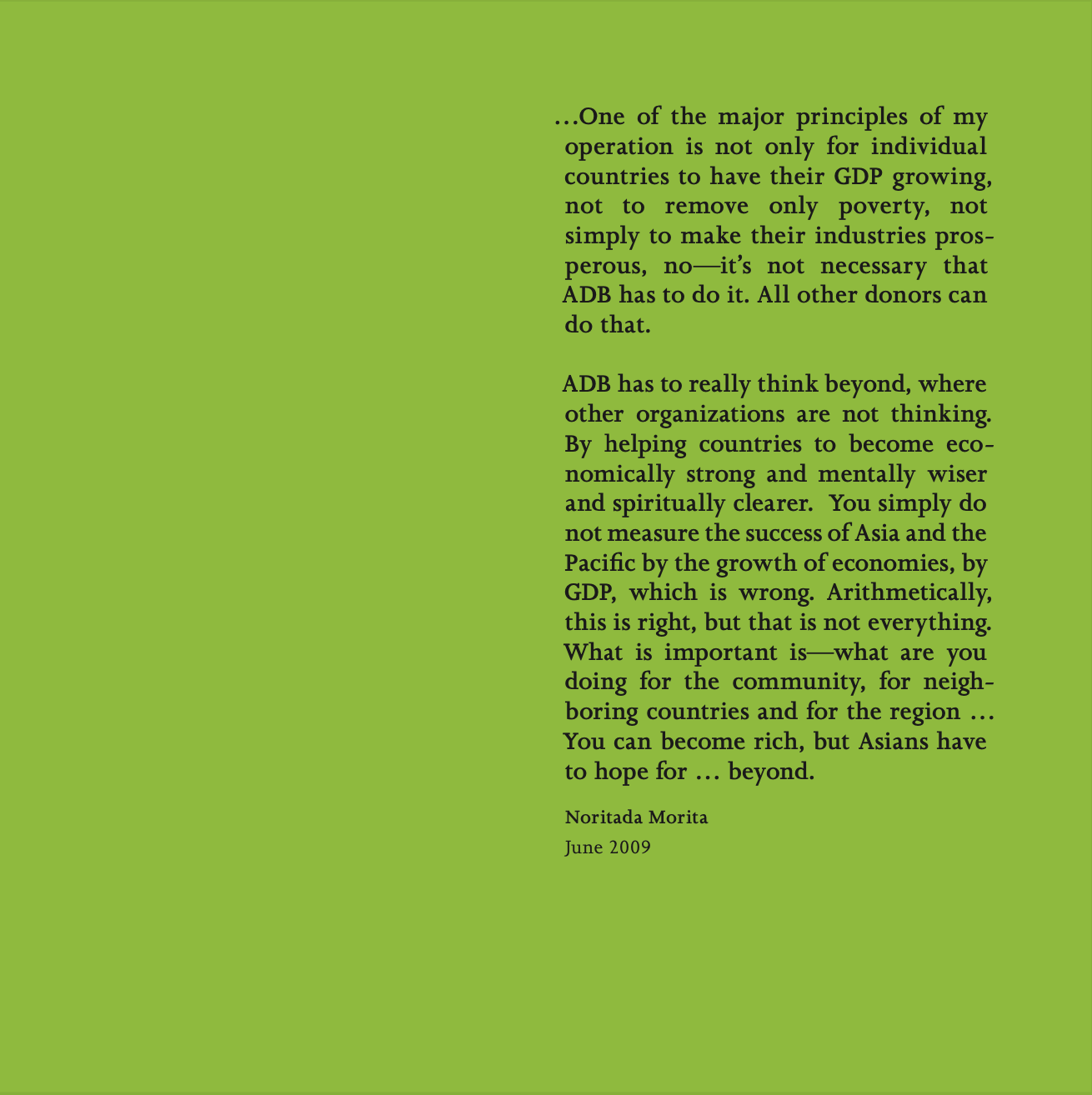
Third, the sheer serendipity, not just of publishing being late, but of being willing to be immersed in the material and going back to revisit the recordings when the transcriptions felt they had something missing. This is how we found beyond which became the perfect name for the works we made together and it is what closes the CD essay booklet:
‘Before you ask me what is the future of Asia in the world, we first have to ask what is the future of the individual countries and individual sub-regions in Asia. Are they relevant within that community? Is ADB guiding them to become relevant? Is ADB’s relevance questioned on that account? No, that is not what the charter expects, but we have to go beyond the charter. We have to measure the success of each country not by following Washing demarcation, financial stability, good central bank, international relations, good savings ratio…so what? You can become rich, but Asians have to hope for….beyond.’
Noritada Morita being interviewed by Carol Russell, June 2009
Behind the scenes
Taken from the end of ‘Reflections and Beyond’

The making of a living archive
Sparknow was commissioned by ADB in early 2009 to conduct a legacy stories project that would provide ADB with a series of assets, including an audio composition, a publication, a series of reusable podcasts, a training program for narrative practitioners, and an embryonic core team of trained practitioners to carry on with the work. Olivier Serrat was the task manager.
For the publication, Olivier asked for a slice of the memories and reminiscences of the organization that would open up new ways for ADB to see and hear itself, and provide new spaces in which hidden and forgotten stories could be told and shared with a wider audience, including the Association of Former Employees of ADB.
We took this challenge to work with ADB to forge an embrace between narrative and analysis, between what is written and what is spoken. In short, to repair the often-ruptured connections between people in an organization and the sometimes impoverished artifacts through which an organization renders itself in written words.
The story began in November 2008, when two of the Sparknow team arrived in Manila at Olivier’s request to inquire into ADB’s use of narrative and identify promising areas where narrative could be applied to bring the experiences and memories of the organization alive. When we returned in March 2009, we decided to map the course of ADB’s history through personal recollections to find clues about where to look. Long tables were laid out in ADB’s library with a timeline by decade. We asked people to plot their own personal turning points, and those they felt to be turning points in ADB’s longer history.
In March 2009 and later in June 2009, we conducted 22 interviews to add to the 11 interviews conducted in November 2008. All interviews were recorded with a main interviewer and a second to take notes. Two additional interviews were later conducted by an ADB narrative practitioner. The process yielded 39 hours of interviews.
The interviews were all transcribed and dropped together with the voice files into a narrative database specifically developed for Sparknow, called kobble. Kobble allows us to fragment voice and text while allowing the fragments to stay connected to the source material. In parallel, we had created a keywording schema that allowed four Sparknow researchers to trawl and sift the materials, looking for themes, patterns, gaps, insights, and anecdotes. We ended up with over 400 fragments, 55 sets, and 240 keywords that were used more than once.
FOUR OTHER THINGS WERE GOING ON AT THE SAME TIME
First, we were thinking and rethinking chapter headings and sequencing that were emerging from the materials. We imagined the journey the reader might want to take through the materials, how he or she might want to piece them together and place themselves in relation to them. Coming at them in their own time and on their own terms, rather than having the stories thrust at them. This also led us back to the original research interviews from November 2008 which, although not conducted in the same manner, also held some important stories and insights. Of course, as we had been interviewing for something different, this was a bit frustrating, because in many cases we could hear the anecdote behind what was being said.
How we wished we had more time to gather: double the length of the interviews, twice round the same interviewee—a chance as narrative practitioners to share our listening with each other and find the probing places where a story was lurking behind someone’s tongue, not quite ready to come out. Polished stones, small stories with surprise and beauty do not drop out on a first encounter. There is archaeology, a careful digging, a brushing down and dusting off, a slowness of savoring and encounter, an intimacy. We got downhearted, and then would go back and look again, and find something new, a tiny entry point that allowed us to play with the material in new ways.
When directing Shakespeare, the great director Peter Hall always starts by sitting down and writing out the whole play longhand to get the skin of it. Sometimes the work we were doing to sift and shape and craft the unrefined materials felt almost physical.
Second, we were researching proverbs and folklore from ADB member countries, knowing that the structures of oral histories alone might not provide enough grammar, as it were, to invite the reader into a relationship with the materials.
Meanwhile Carol was reading Towards a New Asia by Takeshi Watanabe, recommended by Xianbin Yao, the sole copy, a 1977 reprint in English from the original Japanese unearthed by Albert Atkinson, then librarian. We wanted a fix on the history and origins of the Bank, and we wanted a feel for tone of voice.
Third, David, the sound artist who had crept round ADB headquarters recording ceremonial drums that are not normally played and footsteps and tea trolleys, had started work on a composition in sound that would splice small slices of voice together with found sound and music, to create a soundscape of the Bank at work. He had also paid a flying visit to Cambodia to collect voices and sounds from the field to add to our eclectic collection of sounds from the Bank and Manila. The sequencing of the audio composition and of the publication, while echoing each other, could not be the same. They needed somehow to resonate and reinforce without mirroring. We also knew that sometimes one, sometimes the other, could make a stronger point, making the most of the different possibilities of the different media.
Fourth, we were talking with designers and printers and arguing robustly, hotly, over coffee on the 6th floor of the Royal Festival Hall on the South Bank of the River Thames at meeting after meeting about the kind of design and production values that would lightly hook both products together, while creating space between them, that would render lyrical and beautiful, without whimsy or cuteness. Two of us had a particular interest in the manifestos of Italian Futurists from the early 1900s, and in the parole in libertà (words in freedom) experiments in typography that originated there. We decided that parole in libertà rather than woodcuts or illustrations or photographs would, subliminally, provide a way through the materials that would allow them to breathe, and offer inspiration to the reader. This also allowed us to play with form; both in this tradition and in the more recent methods in narrative research which, for example, explore the possibilities of playing transcripts back in poetic structures rather than in prose.
And then the task of sitting down and crafting a first draft. This was followed by detailed and demanding marginalia and annotations, taking the bones of the collection, rattling them a bit, and suggesting how to reset the pieces to make a stronger skeleton. Then days and days of redrafting, nipping and tucking, re-sequencing, bridging, re- clustering, looking at the light and shade that each extract shed on the ones around it, at echoes forwards and backwards that would provide new gateways and pathways. We made an important decision, quite late on, to show people by their initials rather than by their whole names, emphasizing the collective over the individual. Was this the right decision, or would the reader keep flicking backwards and forwards, irritated by not remembering who was who? We went back to names, then back again to initials, a bit unsure of the best way. Olivier drew the line.
And finally, what to call it? The title of the first draft was blunt, stating right up-front that it was a living archive of memories. And after some debate with our sponsor we went away racking our brains. We wanted something that would highlight the lyricism we found in the stories. Here were people who worked hard but still found time for joy and laughter, people who still took time to notice the poetry around them. We had been listening to the audio composition that was to be entitledBeyond: Stories and Sounds from ADB’s Region. We went back to our sponsor, and after further discussion settled on ADB: Reflections and Beyond. It felt right as that linked the publication with the audio composition in just the right way, and described the journey of the book. Reflections of ADB from its yesterdays.
Here then is a volume whose size and weight belie the efforts that went into its construction, not least of all from staff of ADB’s Knowledge Management Center. A memento to accompany ADB personnel old and new, trigger more memories, and open new futures...
The Sparknow team:
Paul Corney, David Gunn, Laura Nokes, Carol Russell, Victoria Ward
December 2009
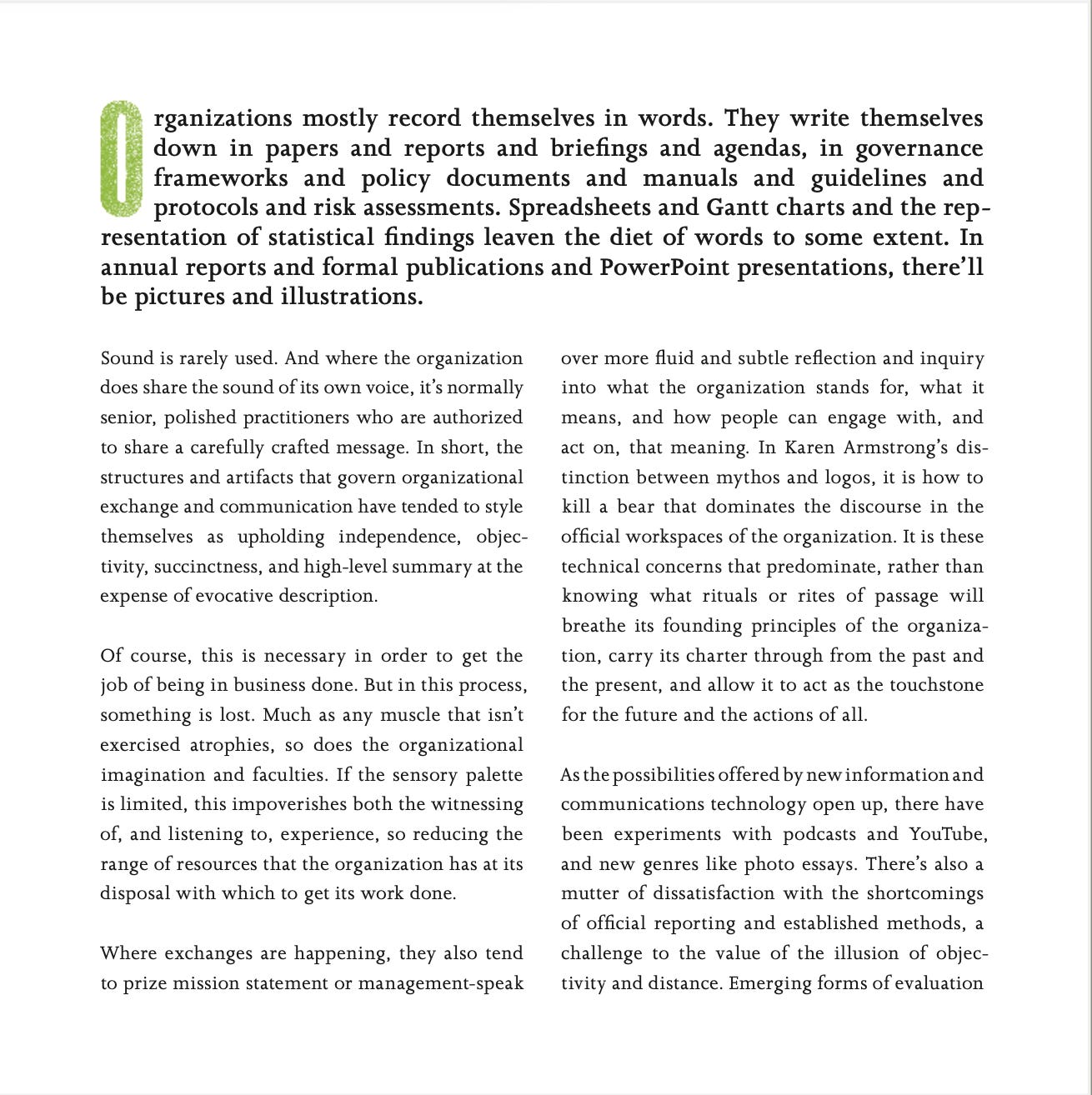
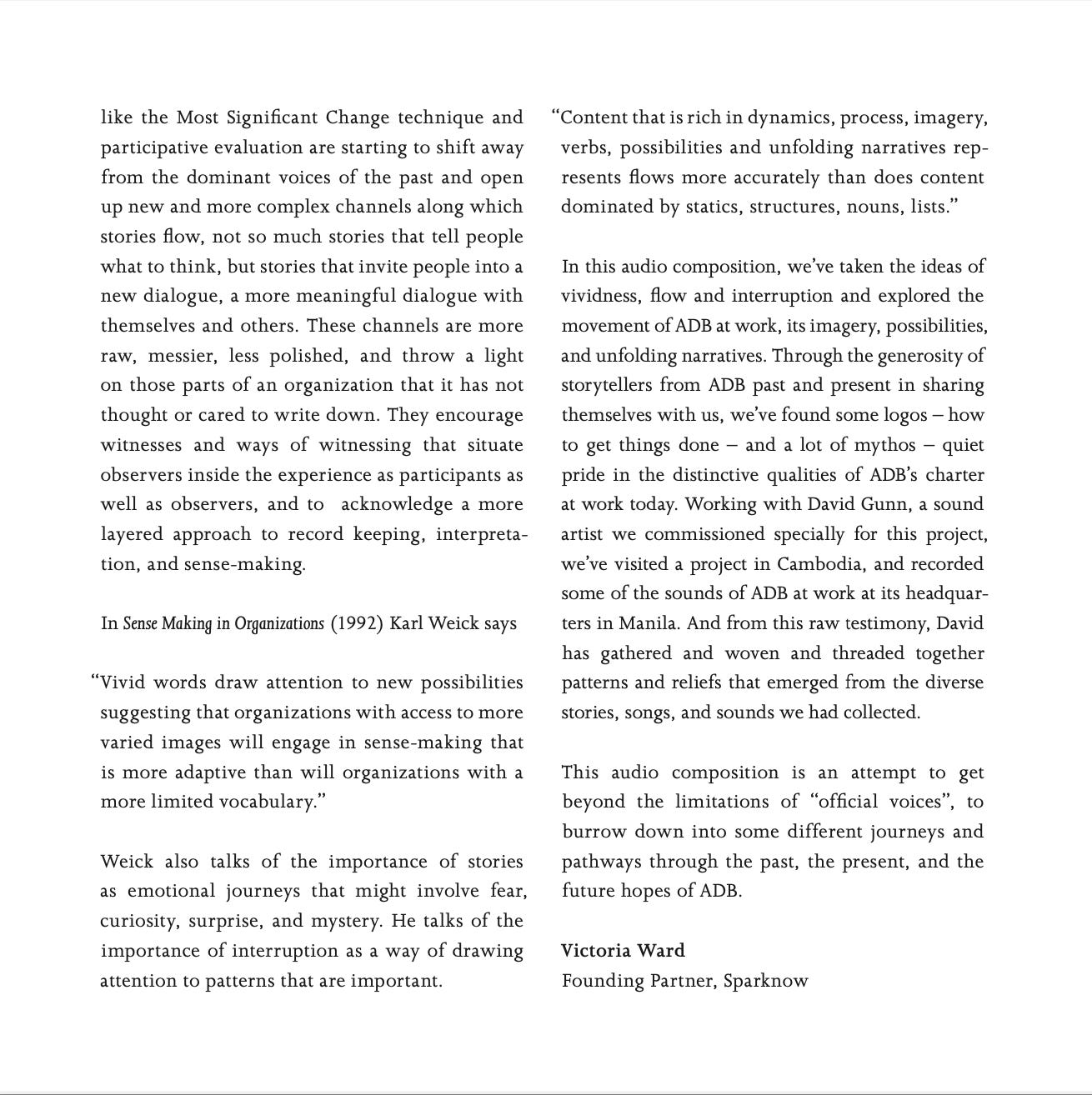
CD booklet
Cultural indicator
Assessing the narrative ecology