
lessons for liberating knowledge
Don’t reinvent the wheel. A lot can be learnt from existing business models, such as franchising

In c.1998 (I think, not clear) Dave Snowden asked me to write a chapter for a little CBI publication, sponsored by IBM called Liberating Knowledge. I teamed with Julie Allan to write a piece around the metaphor of franchising as strong metaphor for setting up and evolving knowledge management systems. I have written about it somewhere else too, to be tracked down. In any case, there are several projects just now in which the philosophy, principles and practices of knowledge and know how franchising are in my mind so I thought I would reproduce it here.
I have chosen not to edit anything that follows except where e.g. a company name has updated. Let us see if it stands the test of time.
_________
Three particular threads of enquiry are interwoven in this consideration of how to liberate knowledge:
1. Why bother creating or claiming ‘new’ approaches and tools for ‘knowledge management’ when we may simply be able to borrow from proven systems?
2. Could individual self-interest and self-governance, nudged into situations where collaborative behaviour is attractive, create ‘knowledge management’ fit to support (and lead) necessary and emerging organisational forms?
3. Can we harness the tensions between accounting approaches and learning-based or community-related approaches to value without compromising either? Since these (among other) viewpoints exist, they are intrinsic to the knowledge process, and the challenge is to negotiate them as part of a multilayered market dynamic.
new organisational structures
Increasingly, formal and informal drives to create effective knowledge structures (both stocks and flows) are moving away from traditional views of boundaries and structures as impermeable and/or fixed. Evolution of products with clients (‘co-evolution’) requires a degree of transparency, decentralisation of responsibility, and a coupling of action to direction and focus that has not previously existed. At online bookstore Amazon.com, clients co-create the content that attracts new clients, and so act more like members than users of a service (Hagel and Armstrong, 1997).The same is true of many new and reinventing enterprises.
This instant feedback loop, and embedding of what is exchanged in the way of information or insight into what is offered as a product or service, can partly be generated with heavy investment in technology. But the ability to anticipate, or the creation of quirky, serendipitous or unexpected connections – both important for new growth – are for the most part achieved through the actions of individual people as they relate to each other (perhaps mediated through technology).
a borrower be…
Using successful business and investment models as a starting point is a worthwhile exploration: it is probable that their knowledge dynamic works well, and is deeply embedded in (or emergent from) the traditions and ways of the enterprise, combining the necessary ingredients of financial success with cultural effectiveness.And we can hardly claim that this is a radical approach, since the overall context of knowledge management exploration has drawn lessons from social systems and approaches, including medieval guilds, hunter-gatherers and the cartography of the middle ages. The role of history, and the ways of interaction that may be seen as successful in a variety of community contexts (business or otherwise), therefore form an important frame for this enquiry, inviting consideration of connectivity, complexity and learning.
franchising
One business model worth investigating for what it may teach is franchising.
Certain attributes, in particular the transparent management of stocks and flows, may be combined with other tools and methods to create a rather pragmatic knowledge management approach fit to support new business purposes. It may also be easier to communicate than some conceptual models, since it rests on business ideas with an existing and documented history.
The trick is not to borrow wholesale, but to identify in the experience and approach of real franchises some backbone of an approach that may inform knowledge management. The value is in deriving from an approach to managing stocks and flows of knowledge (probably not called knowledge management) where the knowledge management has direct alignment with, and is in fact fundamental to, achievement of business purpose and sustainable profits.
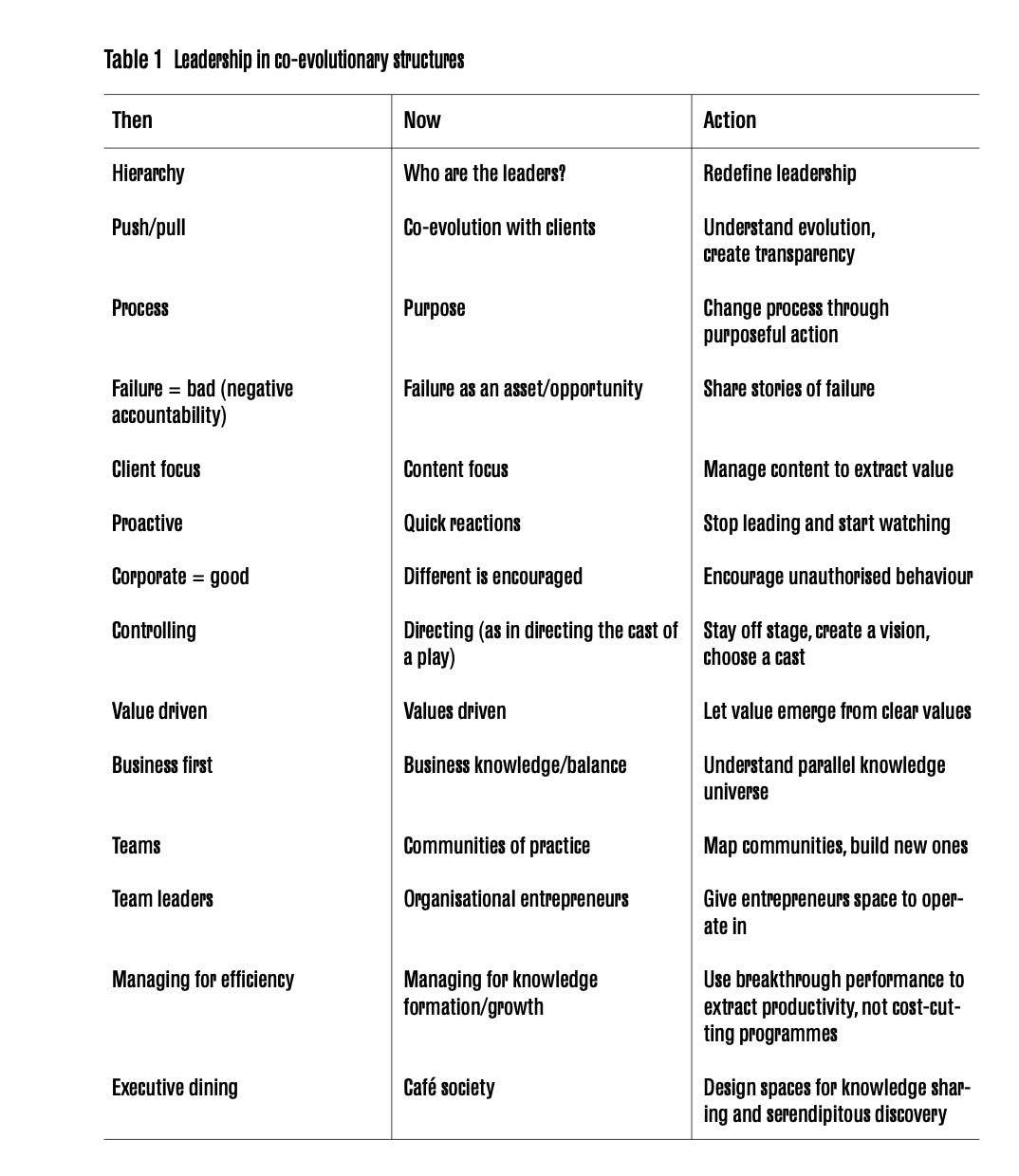
franchiser/franchisee relationship
How does the relationship between franchiser and franchisee work?
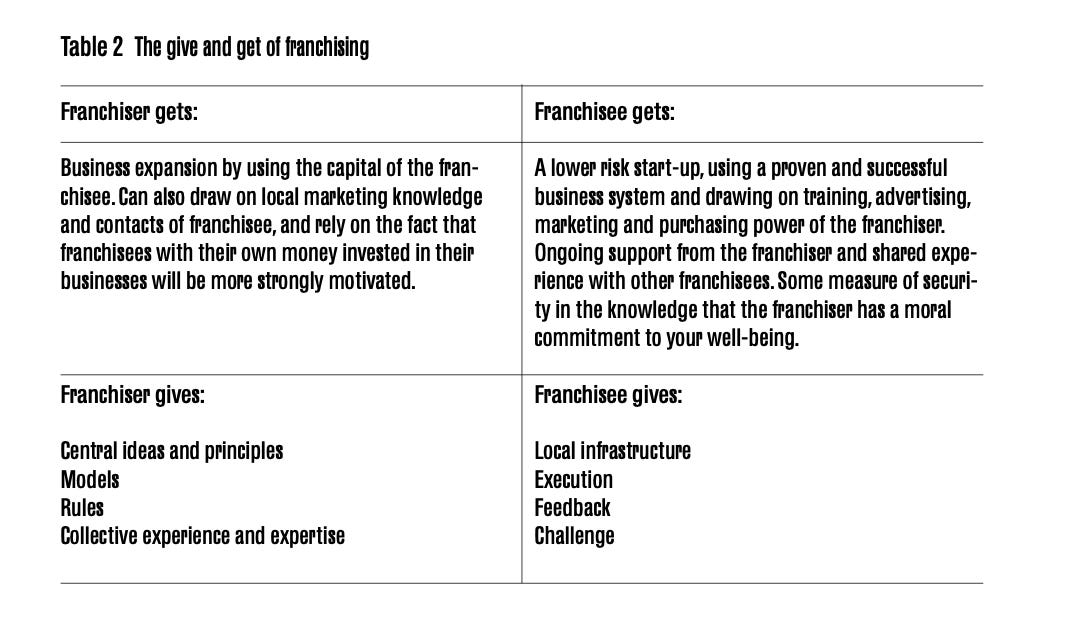
Aspects of this approach that seem to us to offer particular value include
Partnership and interdependence in a network: ‘close interdependence is
unique to franchising and is the major factor which makes the system dif-
ferent from other business opportunities’ (NatWest, 1997).
High ratio of information to infrastructure: if the ratio goes the wrong way,
the franchise will eventually cease to exist.
Two illustrations from real franchise stories are illuminating. If you look at the KallKwik literature, what jumps out at you apart from the role of the central team (proven systems with strong on-going support and a sharply honed marketing department) is the relationship between the 200 or so outlets nationwide: centre owners find each other a rich source of help and information, learning from their experiences.
Or take the illustration of a fast-food franchise. The central team has the skills, experience and partnering arrangements in place to open a new outlet from scratch in two to three weeks. This is because of the central repository of knowledge in building regulations, the strength of the long-term relationships with suppliers of materials and labour and the longer-term relationships in the building sector and with regulators etc.
used as a backbone for knowledge management
Applied to knowledge management, the relationship might be described as in
Table 3.
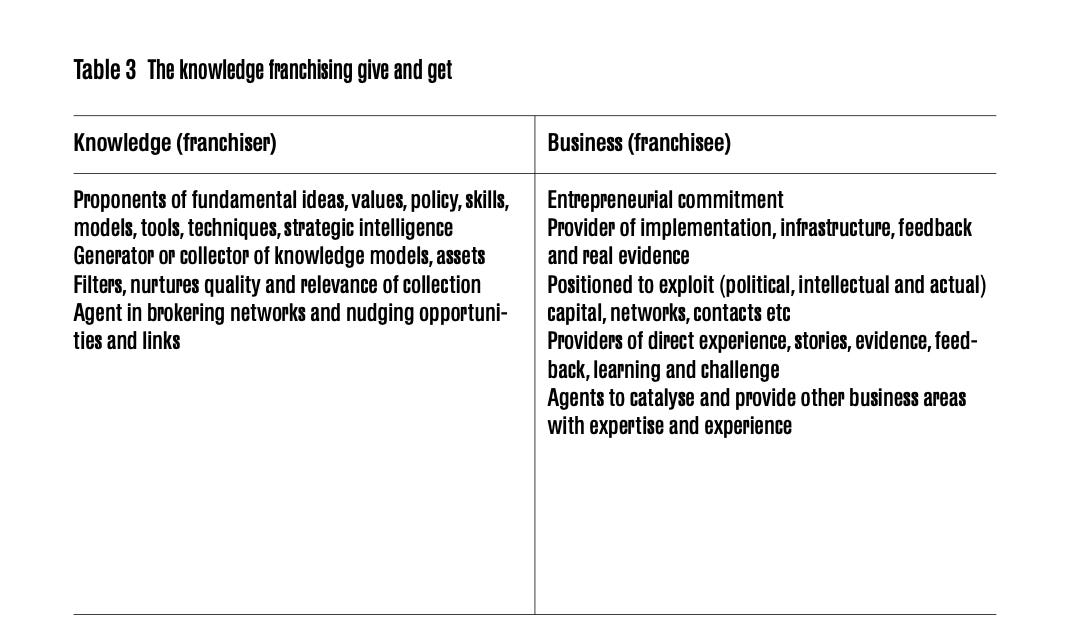
This, of course, is not to suggest that a franchisee cannot, for example, be a generator or collector of knowledge assets; each is in a reciprocal and co-evolutionary relationship. However, as a static snapshot of a moving process, these columns offer a useful starting point for navigation.
connectivity
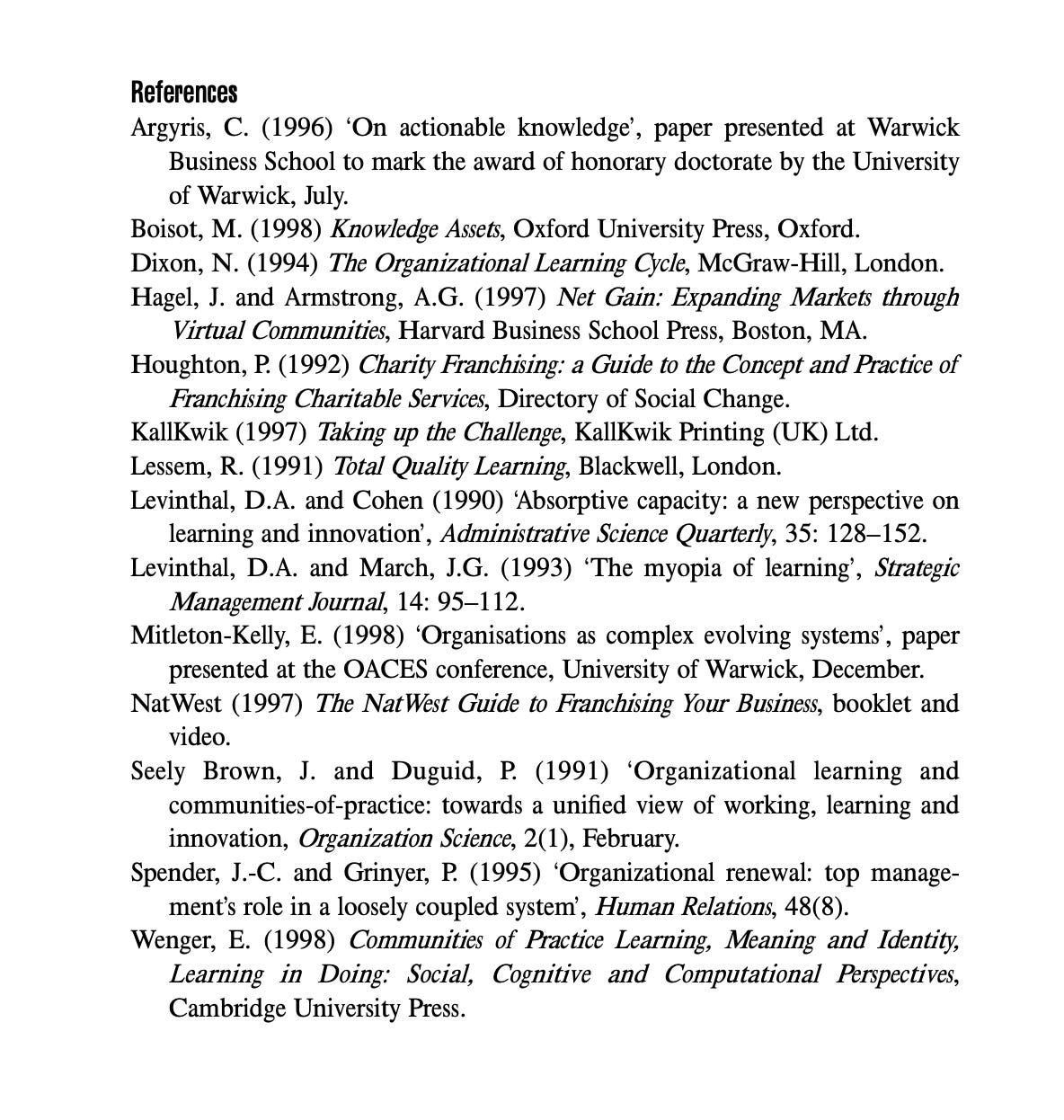
Literature and experience around organisational development (even innovation) contain a consistent call to attend to the importance of connectivity. This appears in many guises, including ‘coupling’ (Spender and Grinyer, 1995), the creation of actionable knowledge (Argyris, 1996), organisational learning (e.g. Dixon, 1994; Levinthal and March, 1993; Lessem, 1991; Seely Brown and Duguid, 1991), knowledge stocks and flows (Boisot, 1998), communities of practice (Wenger, 1998), and complexity (Mitleton-Kelly, 1998).
We suggest that our notion of ‘knowledge franchising’ may address the need for connectivity and be used to counter the dislocation between activity, knowledge and expertise that has been noted in fast-moving environments. It could offer a systematic, even systemic, approach with pragmatism determining short-term activity (appropriate to local conditions) in relationship with an effective, connected structure for a knowledge team.
franchising is interdependence: interdependence generates evolution
Such networked approaches are rooted in complexity and a (w)holistic view, which requires consideration of the role of co-evolution. Rather than simply reacting or adapting to an external pressure, the focus is on continually co-evolving, both influencing and being influenced. In such circumstances, a simple cause–effect link is not apparent and the entity is not seen as being separate from its surroundings. Every successful franchise system continues to evolve with decentralised controls, despite the structural safeguards designed to stop this happening
co-evolution
There is co-evolution between the concept, the contributors (franchisers, franchisees) and the business conditions, for it is through this process that the franchise remains ‘fit’ to trade, suited to its purpose through changing conditions. As part of this process, each franchisee operates in their own interest and the interest of the larger franchise community, to optimise their position in the continually evolving local ‘fitness landscape’
The franchiser transforms this experience through manuals, models, systems, behaviours and so forth, acting as a broker, coach and supplier, and feeds back to the franchisees. And the explicit understanding is that franchisees will take these ideas and translate them into infrastructure as locally appropriate (including feeding back what is/is not suitable for them and why).
emergence
The notion is one of emergence, rather than of centralised control. As David Smith from Unilever put it to one of this chapter’s authors recently:
“I almost forget sometimes that we arrived at knowledge management from strategy and look to biological and complex adaptive system forms as new organisational structures – because that is what organisations are … they have self-acting agents (humans) acting within a set of design principles and the result is emergent and unpredictable.”
The bottom-line utility of this was conveyed to another of the authors by a government colleague, who explained that through an emergent, participative process, priorities had become clear and were worked on in a coherent way that completely avoided the previous competition for, and costly splitting of, resources. The result was greater efficiency and effectiveness.
This example, and notional franchising of knowledges generally, reflects and can be informed by Wenger’s seminal work on communities of practice (1998). Wenger (pp 49–50) talks of practice as having six attributes:
1 Practice as meaning.
2 Practice as community.
3 Practice as learning.
4 Practice as boundary.
5 Practice as locality.
6 Knowing in practice.
In doing so, he defines learning as ‘an interplay of experience and competence’.
This is precisely the essence of the mutuality of a franchise.
the changed nature of boundaries
In a franchise operation, there is a community of inter-related businesses that may benefit from mutual transparency. They may also benefit from some transparency towards competitors if each learns and benefits without losing their unique proposition. Boundaries, instead of defining what is inside and what is outside the enterprise, become something to do with management of content and with behaviours, as with Wenger’s communities, in which the interactions differentiate the group (and one group may be all local businesses, including competitors). At the same time, being part of a recognisable franchise group may arguably provide some area of relative stability that helps learning to occur, including the embedding of useful behaviours, and attends to the tensions between standardisation and innovation, risk taking and risk mitigation. (There is more to be said in another space about the different approaches to risk taking and risk mitigation.)
many-layered market dynamic
One main criticism of knowledge management programmes is that they can seem somewhat soft, squashy and far too cultural for their own good. Where are the measurable benefits? The cause–effect chains to justify the investment?
In fact, critical to the flow of knowledge, and to the distilling and nurturing of the stocks that will generate growth and value, is an understanding of the nature of markets, trading and investment instruments and transactions, both at the level of the way individuals instinctively manage their own transactions and investment in knowledge, and at the level of a networked market dynamic.
A franchising model acknowledges the many layers of market dynamic. It has to be financially successful to survive, but it also has to nurture the internal market, effective networks and mutuality as a cultural necessity, both between the centre and the local businesses and among franchisees.
enlightened self-interest
The knowledge economy rests on the inclination of individuals to volunteer.
Any system must make it attractive for individuals to put their careers and existing cultures at risk for an unknown reward. A franchise approach can create a coherent narrative within which individuals can locate and negotiate or influence their own position and role in relation to others. (This view is consistent with the body of work drawing on anthropology, social psychology and related disciplines connecting the function of narrative and/or storytelling with organisational development in general.)
Business sponsors of knowledge projects act as entrepreneurs with backing from the knowledge team; and as voluntary franchisees they also have a framework of experience and committed support to work with. The social and intellectual capital generated by them as individual entrepreneurs feeds into, and draws from, the knowledge franchise, evolving a substantial and sustainable process.
Individuals who engage (in the business, in the knowledge team) are collaborating to further their own careers, abilities and opportunities. They can consciously grow their intellectual capital through measured risk taking, and use their political capital in the organisation, converting it into new social capital and economic value for themselves and for the enterprise. They are much more likely, as a consequence of the mutual commitments emerging from such a framework, to contribute ideas and experiences that would otherwise remain as individual tacit knowledge.
critical quirks
Explicitly building collections of knowledge and experience around a small set of governing principles or rules creates transparency and emergent effective governance. This can, over time, replace the central authority that typically governs an organisation with a kind of decentralised informed argument combined with individual access to jointly developed resources. It is this, individual-centred approach, where the systems, processes and infrastructure support the direct ability of individuals to act and anticipate, which will retain (and energise) the critical quirks and unexpected insights from which new growth will emerge.
references
Julie Allan is an independent organisational psychologist who specialises in systemic approaches to organisational and individual development.
Victoria Ward is the founder of Hyphae Spark Knowledge, a research and consulting business whose assets are a fund of stories, a network of experts and the Hyphae Spark business model.
********
END
*******
postscript from November 2025
Also, now that I am on the BSI Knowledge Management Systems Committee, as incoming chair, my KM archives need unearthing. A little gloss, looking back from over 25 years later, is that in fact, what I am partly talking about here is deeply grounded metaphors. Causal Layered Analysis would have been an extra lens to apply and I might return to it with that in mind. Also, I wonder if we would have introduced the engineered outputs of generative AI into this if we were writing it today. A secret history here is that this is adjacent to what I learned in my role as director product development in the London International Financial Futures exchange. Knowing what it takes to devise an exchange traded derivative that builds critical mass and market share is what lies deep beneath. I may explain more at some stage. In any case, what it takes to design and deliver a change progamme that builds coalitions around change is, in my case, strongly informed by ideas from franchising and product design.