
fright and futures
a guest blog from Caitlin McDonald, our Dr of all things Plague teasing out ideas about fright and futures work and how we build campfires of safety and frightening times

To help us celebrate this Halloween, we’d love to hear more about how you’re thinking about the challenges of psychological safety in participatory futures studies processes: your best workshop facilitation techniques; your favourite communications strategies.
When do you enjoy being frightened and when don’t you?
What do you do to keep things imaginative while acknowledging the challenges of change?
What are your treats?
What are your tricks?
Halloween is a time of betwixt and between, a time for us to confront our demons, rake skeletons out of the closet, and allow the ghosts of the past to haunt us. In which spirit, this is an exploration and explanation of Plague Season, Hyphae’s (then Jigsaw Foresight’s) playful provocation to examine what we’ve learned in the five years since Covid-19 lockdowns radically changed the way we all lived.
Plague Season served several purposes: it allowed us to cast back to where we’d been and think about how far we’ve come. It allowed us to imagine forward and think about what might happen if we faced similar (or different) world-altering shocks in future. And it allowed us to think about the relationship between psychological safety, imaginative capacity, and change-readiness in participatory futures processes.
“Plague” is a usefully ambiguous word: its most common usage now is to mean an epidemic, particularly a highly infectious one with a high mortality rate (most specifically, the disease caused by the zoonotic bacteria Yersinia pestis, of ‘plague doctor’ fame.) But it can also mean a divine punishment or retribution, as in Exodus (locusts, rain of blood, etc); an unusual or sudden calamity (Queen Victoria describes “a plague of wasps” in her Highland Journals of 1877); or, hyperbolically, a minor vexation (a plague of reminder notifications, a plague of roadworks, plagued by my own conscientiousness, etc.) And a plague can be used in anger, per Shakespeare: “a plague on both your houses!” These layers gave us scope to create a conversation that could be both playful and serious – even frightening.
Over the course of three workshops, we asked participants to imagine what might happen if three completely different kinds of plagues were to combine into one mega-plague – and most importantly, what they would need to survive the aftermath of whatever this imagined mega-plague became. Not merely their physical survival, but their psychological resilience: what are the things that you would use to keep hold of your sense of humanity when the familiar world seems lost, and you’re faced with making a life for yourself in an entirely new way? This is the core question of Plague Season.
In many ways, this is also a core question of futures studies: the World Futures Studies Federation includes among its guiding principles of futurists the tenet that
“Instead of strengthening the spirit of despair and surrendering to the future that is already known and determined in advance, they encourage people and organizations towards systematic and cooperative awareness and networking to achieve their ideals and realize their visions that indicate their desired future.”
But how does that play out in practice? How, exactly, do futurists steer away from the spirit of despair and towards ideals and visions of a desired future? Ignoring frightening futures won’t keep them from happening – but the stress and survival mode of imagining undesirable futures can limit people’s creativity in coming up with options for change. The fight, flight or freeze response is an instinctive reaction to a perceived threat which puts the brain on autopilot, creating tunnel vision that focuses on the immediate fear rather than seeing the whole picture. This is the opposite of the expansive imaginative zone which is needed for creative thinking.
Somehow in Plague Season, we needed to create the conditions for expansive imaginations while talking about threatening topics. And indeed, even for topics that seem on the surface less threatening, all change pushes people into the unknown, a potentially threatening experience. This is where psychological safety comes into play.
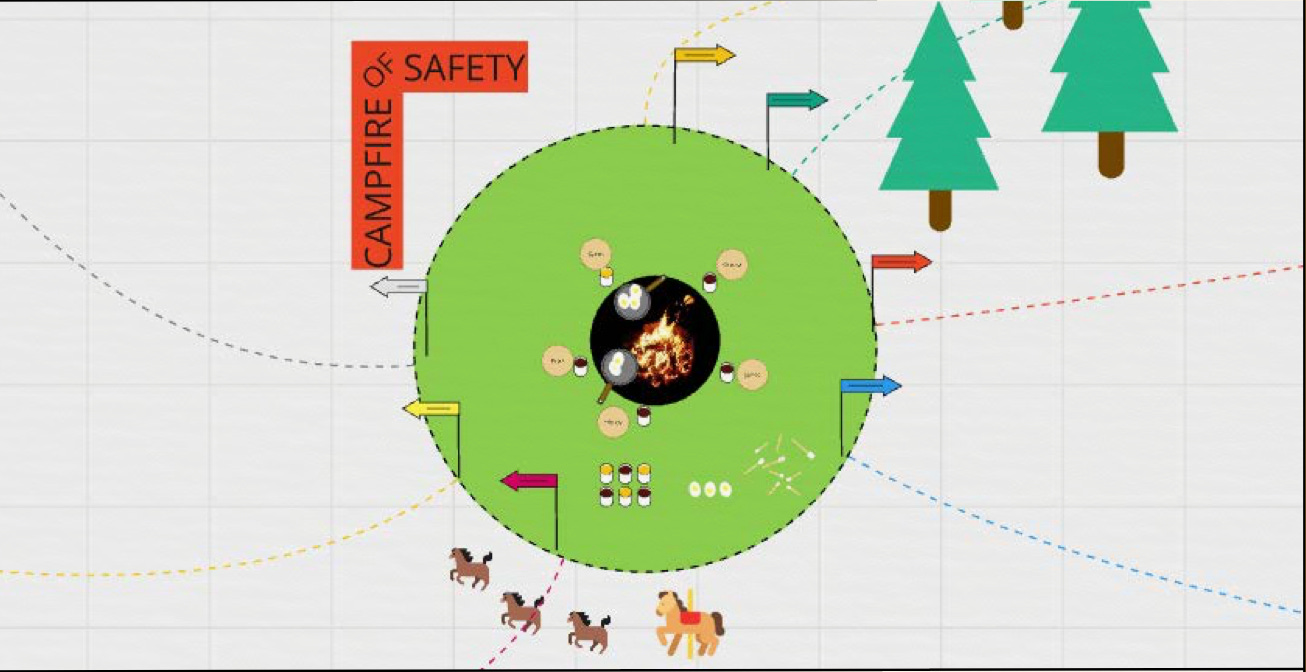
For Plague Season, we devised several interventions that emphasised psychological safety: the visual design and language of the experience was playful before participants arrived and during the workshops. We had spaces away from the main workshop area where participants could retreat if they needed a break from the overwhelm. We had facilitators trained in coaching techniques and in mental health first aid. Though participants didn’t actually end up using any of these, having them to hand gave both participants and facilitators the confidence to proceed with depth and frankness about potentially distressing topics. They’re a bit like having a fire extinguisher and a first aid kit available: you hope you never need them, but you’re very glad to know they’re around.
This is, perhaps, an unspoken plague of futures studies: how are we working to ensure the psychological safety of our participants? Not only because it’s an important and responsible thing to do for participants’ individual resilience and robustness, but also because by doing so, the results of their discussions will go further and deeper? This is an important part of “creating better systematic and cooperative awareness and networking to achieve their ideals and realize their visions.” My colleague Wendy Schultz and I are working on a longer paper about this very problem which we will share widely when ready.
Everything about Plague Season, including the scenarios developed by participants, a speculative short fiction story, some interactive ‘plague sounds’ based on the scenarios, and our Plague Season facilitator’s guide, is available on the Plague Season website.